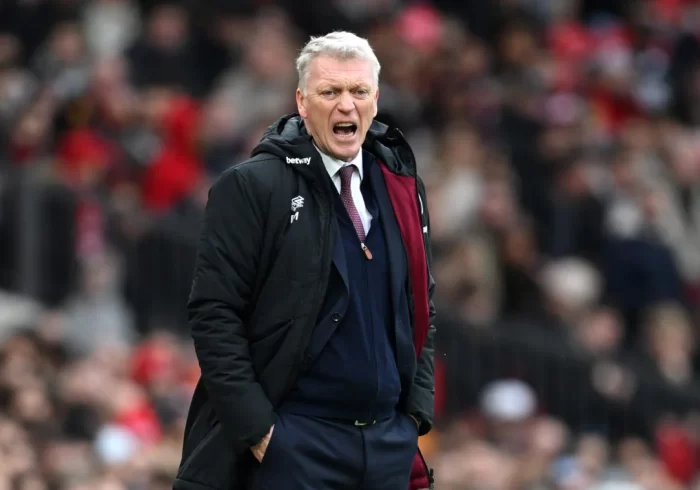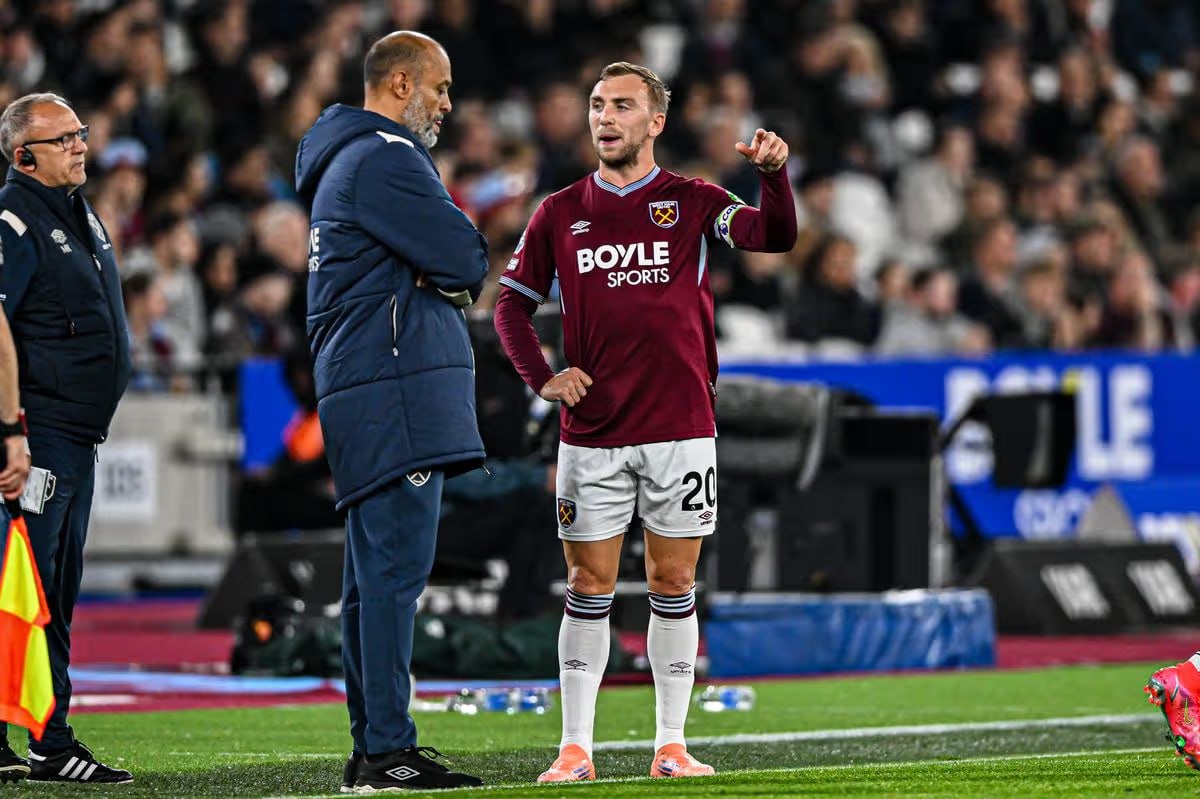
West Ham United endured a frustrating afternoon at Villa Park as they slipped to a 2-0 defeat against Aston Villa—but both manager Nuno Espírito Santo and captain Jarrod Bowen were quick to pinpoint exactly where things went wrong.
And their verdict was identical: the pressing simply wasn’t good enough.
A Game Defined by One Major Flaw
Coming into the clash, there was a sense that West Ham could build momentum, especially after some promising recent displays. However, that optimism quickly evaporated as Villa dominated proceedings from the outset.
According to Nuno, the Hammers never found their rhythm—particularly out of possession.
“We were not able to run, press and lost a lot of duels,” he admitted post-match. “I never felt the team was in the right place.”
That lack of coordinated pressing allowed Villa’s midfield to dictate play with ease. Players like John McGinn and Morgan Rogers consistently found space between the lines, exposing gaps in West Ham’s structure.
Bowen echoed his manager’s concerns, highlighting how Villa repeatedly exploited those spaces:
“They played well between our lines… they created a lot of opportunities that we didn’t do well enough to prevent.”
Early Disruption Didn’t Help
West Ham’s game plan suffered a major blow even before kickoff. Defender Jean-Clair Todibo was ruled out during the warm-up, forcing Nuno into a last-minute tactical reshuffle.
The Portuguese boss abandoned his preferred back-three system and switched to a back-four, bringing Freddie Potts into the starting lineup.
While Nuno refused to use that as an excuse, the disruption clearly had an impact.
“It is always a problem losing a player in the warm-up. It changes things,” he explained.
The new shape appeared disjointed, particularly in midfield where Potts and Tomáš Souček struggled badly. In fact, neither player registered a single successful tackle—an alarming statistic that underlines just how ineffective West Ham were defensively in central areas.
Villa’s Midfield Dominance
Aston Villa’s midfield unit completely overran their counterparts. Alongside McGinn and Rogers, Amadou Onana and Ross Barkley controlled the tempo, combining physicality with intelligent movement.
Rogers, in particular, was a constant threat. His driving runs caused chaos, and one such surge led to the second goal, finished by Ollie Watkins in the 68th minute—a strike that effectively killed the game.
Despite some improvement after halftime, West Ham never truly looked like mounting a comeback.
Tactical Tweaks Fell Short
Recognizing the issues, Nuno made changes at the break, introducing Callum Wilson and Adama Traoré to inject pace and attacking threat.
While the Hammers did show more intent in the second half, the fundamental problem remained unresolved: they could not press effectively or regain control in midfield.
By the time Watkins doubled Villa’s lead, the contest was effectively over.
Questions Moving Forward
This defeat raises serious concerns for West Ham as the season approaches its critical final stretch. The inability to execute a basic pressing structure—something both manager and captain highlighted—suggests deeper tactical or personnel issues.
For Nuno, the challenge is clear: find a way to restore cohesion quickly. For Bowen, the focus will be on leadership and ensuring the team responds positively.
What makes this loss particularly worrying is not just the result, but the manner of it. West Ham were second-best in every department—physically, tactically, and mentally.
If they are to avoid further setbacks, addressing their pressing game will be non-negotiable.
Because as both Nuno and Bowen made clear—this wasn’t about fine margins.
It was about getting the basics wrong.