The San Antonio Spurs are no longer a rebuilding project—they’re a team with real ambition. With Victor Wembanyama rapidly evolving into one of the league’s most dominant forces, the franchise is entering a new phase: competing now while carefully planning for the future. And one of the biggest questions quietly looming over this transition is what comes next at the power forward position.
For now, that role belongs to Harrison Barnes—a seasoned veteran whose value extends far beyond the stat sheet. Barnes brings championship experience, professionalism, and stability to a young roster still learning how to win. His ability to space the floor, knock down perimeter shots, and provide leadership has made him an essential piece of the Spurs’ current structure.
However, time is undefeated.
Barnes is approaching his mid-30s, and while he remains productive, it’s clear that the Spurs must begin preparing for life after him. His scoring output and overall impact, while still solid, are not what they once were. For a team with championship aspirations in the near future, relying too heavily on an aging player at a key position could become a limitation.
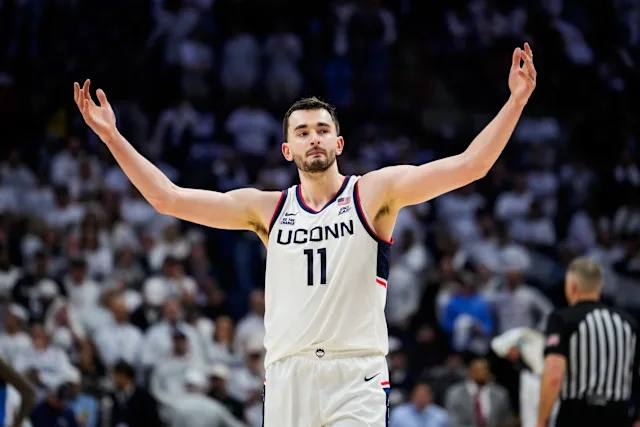
That’s where the idea of a successor comes into play—and one name is starting to gain traction: Alex Karaban.
Currently starring for the UConn Huskies, Karaban has quietly built a reputation as one of the most reliable and intelligent forwards in college basketball. He may not possess elite athleticism, but what he lacks in explosiveness, he makes up for with skill, awareness, and composure.
Karaban’s recent performances have only strengthened his case. In the NCAA Tournament, he delivered back-to-back standout games, including a career-high scoring display that showcased his ability to step up in big moments. Whether it’s hitting timely three-pointers, moving without the ball, or making smart decisions under pressure, Karaban consistently finds ways to impact winning.
And that’s exactly the type of player San Antonio values.
The Spurs have long built their success on identifying high-IQ players who fit into a team-first system. Karaban fits that mold perfectly. His shooting ability makes him an ideal floor spacer—much like Barnes—while his understanding of the game allows him to seamlessly integrate into structured offensive sets. He doesn’t need the ball to be effective, which is crucial on a roster that already features ball-dominant talents.
More importantly, his skill set complements the Spurs’ core.
With Wembanyama commanding attention in the paint and emerging guards like Stephon Castle helping to drive the offense, there’s a clear need for players who can operate off the ball and capitalize on open looks. Karaban’s ability to stretch the floor and make quick, smart decisions would make him a natural fit alongside these pieces.
Of course, he isn’t a perfect prospect.
Karaban’s lack of elite athleticism could limit his defensive ceiling at the NBA level. He’s unlikely to become a lockdown defender or a player who can consistently guard multiple positions against top-tier talent. Additionally, he may never develop into a primary scoring option. Instead, his projection is that of a high-level role player—someone who contributes in multiple ways without being the focal point.
But for the Spurs, that might be exactly what they need.
This is no longer a team searching for its next superstar—they already have one in Wembanyama. The focus now is on building a well-rounded roster that maximizes his strengths and creates a sustainable winning environment. In that context, a player like Karaban becomes incredibly valuable.
There’s also the financial and strategic advantage of finding such a player in the draft, particularly in the second round where Karaban is projected to be selected. Securing a reliable contributor on a cost-controlled contract would give the Spurs flexibility to address other needs, whether through trades or free agency.
Ultimately, the decision comes down to vision.
Do the Spurs chase a high-upside prospect with star potential, or do they prioritize fit, reliability, and basketball IQ? If they choose the latter, Alex Karaban could be the perfect answer hiding in plain sight.
As Harrison Barnes continues to provide steady production in the present, the Spurs have a unique opportunity to prepare for the future without rushing the transition. And if they play their cards right, they may once again prove why they are one of the smartest organizations in basketball—by finding the right player before everyone else realizes his value.