The Boston Celtics showed resilience and adaptability in their win over the Atlanta Hawks, overcoming a sluggish start with tactical adjustments, standout individual performances, and a disciplined defensive approach.
Early in the game, Boston struggled to find any offensive rhythm. Head coach Joe Mazzulla was forced to call multiple timeouts unusually early, highlighting just how disjointed the team looked. Their possessions were largely unproductive, consisting of contested mid-range shots, pull-ups, and floaters rather than high-quality attempts near the basket. Atlanta’s defense played a major role in this, compressing space effectively and limiting driving lanes without overcommitting to Boston’s shooters.
However, those early timeouts proved to be a turning point. The Celtics began to shift their offensive strategy, focusing on attacking the rim instead of settling for difficult perimeter looks. By increasing off-ball movement and exploiting Atlanta’s switching defense, they were able to generate more favorable matchups. This led to easier scoring opportunities, especially as players cut into open space created by defensive mismatches.
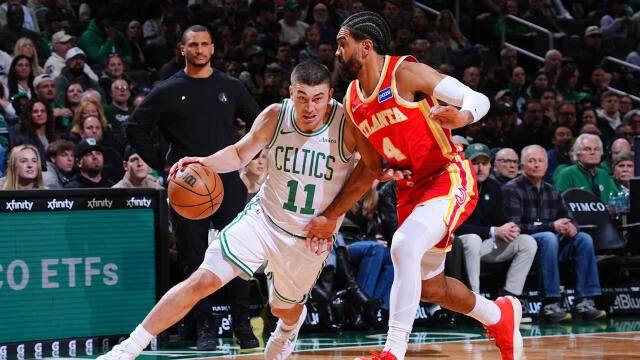
A key factor in Boston’s turnaround was their ability to capitalize on the Hawks’ defensive breakdowns, particularly against bench units. The Celtics’ depth became evident as non-starters stepped up and injected energy into the game. One player who completely changed the momentum was Payton Pritchard, who delivered an explosive performance. Scoring 36 points, Pritchard consistently attacked early in possessions, taking advantage of unsettled defenses. His aggressive style, combined with quick decision-making, allowed him to score both at the rim and from beyond the arc.
But Pritchard’s impact went far beyond scoring. As Mazzulla pointed out postgame, his contributions in ball-handling, rebounding, and hustle plays were just as important. He created multiple second-chance opportunities through offensive rebounds and showed toughness by drawing fouls in critical moments. His all-around effort demonstrated a commitment to winning that extended beyond putting points on the board.
Defensively, Boston executed a smart and disciplined game plan. One of their key strategies involved minimizing the impact of Atlanta’s weaker shooters. By assigning Neemias Queta to guard Dyson Daniels, the Celtics were able to effectively ignore Daniels on the perimeter and use Queta as a roaming presence in the paint. This created congestion inside, making it much harder for Atlanta to generate efficient offense. The Hawks attempted to adjust by increasing movement and attacking the paint, but the lack of spacing disrupted their flow and limited their effectiveness.
Another focal point was containing Jalen Johnson, a versatile offensive threat. The Celtics prioritized stopping his drives over contesting his outside shots, even if it meant allowing him to attempt pull-up threes. By packing the paint and providing help defense from the nail, Boston took away high-percentage looks and forced Atlanta into less efficient scoring options.
Offensively, the Celtics also utilized Queta in a unique playmaking role. Positioned at the nail, he acted almost like a quarterback, facilitating actions and finding cutters as plays developed. This approach added another layer to Boston’s offense, allowing players like Jayson Tatum to exploit gaps in the defense with timely cuts and finishes near the basket.
The game also featured a brief experiment with a small-ball lineup, with Tatum operating as the center. While this approach had mixed results, it showed potential as a strategic option moving forward. The lineup created better spacing and mismatch opportunities, though it also exposed some defensive vulnerabilities, particularly in rim protection and off-ball awareness.
Another notable contributor was Jordan Walsh, who stepped up after a stretch of limited playing time. He made the most of his opportunity by playing with energy and discipline. Offensively, he took smart shots and contributed on the glass, while defensively he was active in contesting shots and staying engaged against opposing guards like CJ McCollum. His performance highlighted the importance of readiness and depth within the roster.
Overall, the Celtics’ victory was a testament to their ability to adjust under pressure. After a poor offensive start, they found solutions through smarter shot selection, improved movement, and tactical flexibility. Combined with standout individual efforts and a well-executed defensive plan, Boston was able to flip the script and secure the win.