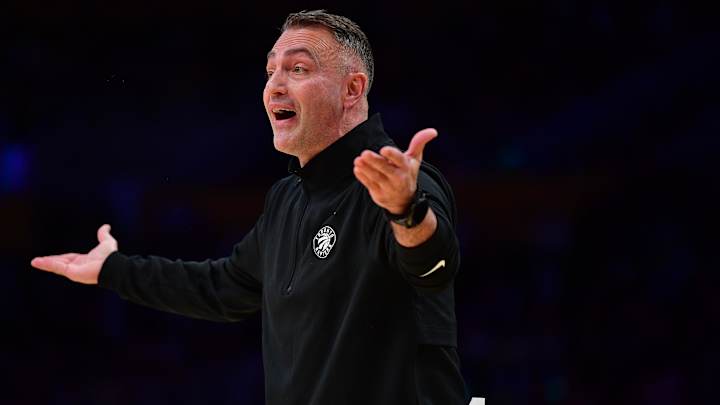
The Toronto Raptors’ 2025–26 season is shaping up to be one of the most surprising campaigns in the NBA, and the numbers behind their success make it even more impressive.
After finishing with just 30 and 25 wins in the previous two seasons, Toronto has surged to a 44–35 record and currently holds the sixth seed in the Eastern Conference. While they remain close to the play-in zone, the leap in performance has already exceeded expectations set before the season began.
What makes this turnaround even more remarkable is a glaring weakness that continues to follow the team—three-point shooting.
Despite building their identity around fast-paced offense, strong ball movement, and aggressive defense, the Raptors have struggled significantly from beyond the arc. This issue becomes even more concerning when looking at their efficiency on wide-open three-point attempts—arguably the easiest shots in modern basketball.
As a team, Toronto is converting open threes at roughly a 36 percent rate on about 20 attempts per game. While that number may not seem disastrous at first glance, it places them among the weaker shooting teams in the league, especially when compared to top contenders who capitalize more consistently on those opportunities.
Individually, players like RJ Barrett and Jamal Shead have been highlighted as part of the problem, with inconsistency from deep affecting the team’s overall efficiency. Other key contributors, including Scottie Barnes and Gradey Dick, have also had their struggles in converting open looks.
Yet, despite this clear flaw, the Raptors continue to win.
Their success can be attributed to a strong team identity built on unselfish play and defensive intensity. Toronto has excelled in generating open shots through high assist numbers and fluid ball movement, even if they haven’t always converted those chances. Their ability to push the pace and disrupt opponents defensively has allowed them to stay competitive against stronger teams.
Interestingly, the Raptors are not alone in this struggle. Several elite teams, including the Oklahoma City Thunder and San Antonio Spurs, have also ranked lower in certain three-point efficiency metrics while still maintaining high levels of success. This suggests that while shooting is crucial, it is not the only path to winning.
However, the limitations of poor shooting become more evident in high-pressure situations. Throughout the season, there have been moments where opposing teams exploited Toronto’s inability to hit open shots, turning games in their favor.
Looking ahead, this could be the key factor that determines how far the Raptors can go. If they can improve their shooting—either through player development or offseason additions—they could transform from a solid playoff team into a legitimate contender.
For now, though, their ability to maintain a strong record despite such a critical weakness stands as one of the most impressive and underrated stories of the NBA season.