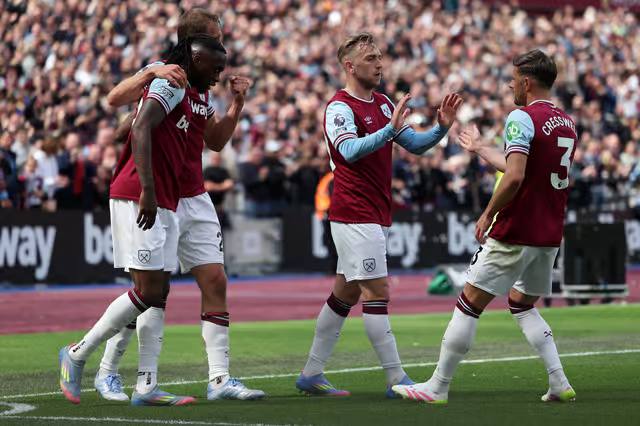
West Ham United’s historic connection to the World Cup is etched into football folklore. The famous claim that the Hammers “won the World Cup” stems from 1966, when three of their players—Martin Peters, Geoff Hurst, and Bobby Moore—played pivotal roles in England’s triumph on home soil. Nearly six decades later, however, the East London club may be on the verge of achieving something arguably more remarkable in the modern era: sending a record number of players to a single World Cup tournament.
As preparations intensify for the 2026 World Cup, West Ham could have as many as six representatives competing across various national teams. Tomas Soucek (Czech Republic), El Hadji Malick Diouf (Senegal), Aaron Wan-Bissaka (DR Congo), Crysencio Summerville (Netherlands), Mateus Fernandes (Portugal), and club captain Jarrod Bowen (England) are all in contention for selection. Should all six secure their spots, it would mark the highest number of West Ham players ever to feature at a World Cup.
This potential milestone highlights how much the game—and the club—has evolved since 1966. Back then, West Ham’s influence was concentrated within England’s squad. Today, the club’s reach is global, reflecting the international diversity of modern football. The possibility of six players representing six different nations underscores both West Ham’s recruitment strategy and the increasingly interconnected nature of the sport.
Historically, the club has come close to such numbers. At both the 2010 World Cup in South Africa and the 2022 tournament in Qatar, West Ham had five players involved. In 2022, Declan Rice represented England, Alphonse Areola was part of France’s squad, Lucas Paquetá featured for Brazil, Nayef Aguerd played a key role in Morocco’s historic run to the semi-finals, and Thilo Kehrer was included in Germany’s roster.
Similarly, in 2010, five Hammers players made the tournament, including England goalkeeper Rob Green, whose early mistake against the United States became one of the competition’s most talked-about moments. Valon Behrami (Switzerland), Guillermo Franco (Mexico), Jonathan Spector (USA), and Matthew Upson (England) also featured. That number could have been even higher if Scott Parker and Benni McCarthy had not narrowly missed out on final squad selections.
Looking ahead to 2026, the likelihood of breaking that record appears strong—though not without uncertainty. Some players are more assured of their places than others. Tomas Soucek remains a key figure for the Czech Republic, while Jarrod Bowen continues to battle for a spot in England’s competitive attacking lineup. Despite being considered a third-choice right winger, Bowen’s consistency and experience could work in his favor.
Elsewhere, Crysencio Summerville is emerging as a serious option for the Netherlands, having impressed despite limited senior international exposure. Mateus Fernandes has recently broken into Portugal’s squad but faces stiff competition in a talent-rich midfield. Meanwhile, Wan-Bissaka and Diouf will also need to maintain form and fitness to secure their international roles.
Regardless of the final selections, the mere possibility of six West Ham players at the 2026 World Cup reflects the club’s growing stature. While matching the iconic impact of 1966 may be unrealistic, setting a new participation record would symbolize a different kind of achievement—one rooted in global relevance rather than singular national glory.
In the end, West Ham may not “win the World Cup” again in the traditional sense. But by sending their largest-ever contingent to football’s biggest stage, they could still make a statement that resonates across the modern game.