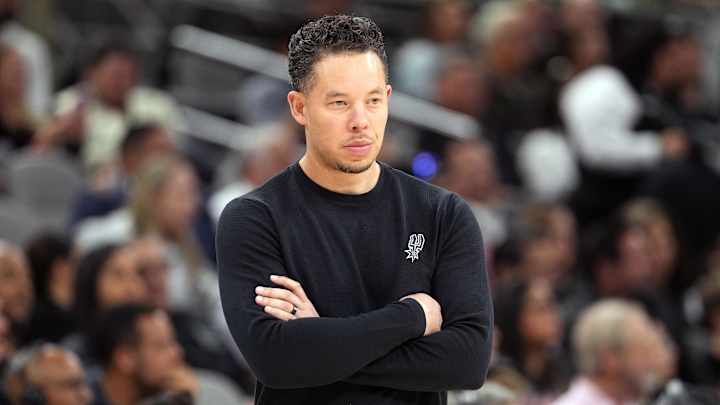
The have emerged as one of the standout teams in the NBA this season, exceeding expectations and positioning themselves as serious contenders. However, as the playoffs approach, growing concerns are beginning to surface around head coach and a potentially costly weakness that could be exposed under postseason pressure.
Despite their impressive regular-season form, the transition to playoff basketball presents an entirely different challenge. The intensity rises, tactical adjustments become sharper, and mistakes are punished more severely. For Johnson, who is navigating his first full season as a head coach, this shift could prove decisive.
A key issue highlighted in recent games is Johnson’s heavy reliance on star guard , particularly in clutch situations. While Fox has built a reputation as a reliable closer and remains one of the team’s most dynamic offensive weapons, his performances have not always been consistent. This inconsistency was evident in the Spurs’ recent loss to the , where Fox struggled significantly.
In that matchup, Fox logged heavy minutes but failed to deliver at his usual standard, shooting inefficiently and missing all of his attempts from beyond the arc. In a tightly contested game, even a marginal improvement in his shooting could have altered the outcome. Instead, the Spurs were left to reflect on what might have been—a scenario that could become all too familiar if adjustments are not made.
The bigger concern is not just Fox’s off-night, but Johnson’s reluctance to adapt in real time. Even as Fox struggled, the coach continued to trust him in crucial late-game moments, overlooking alternative options available on the roster. This decision-making pattern raises questions about flexibility and in-game management—qualities that are essential for success in the playoffs.
One such alternative is rookie guard , who has quietly built a case for increased responsibility. Harper brings a different skill set to the table, particularly his ability to attack the rim and create scoring opportunities in high-pressure situations. His development on both ends of the floor, including noticeable improvements in three-point shooting, makes him a viable option when Fox is struggling.
However, the reluctance to trust a rookie in crunch time is understandable, especially in high-stakes scenarios. Playoff basketball often favors experience, and handing responsibility to a young player carries inherent risks. Yet, the Spurs’ depth at the point guard position was designed precisely for moments like these—to provide flexibility and adaptability depending on game flow.
Another critical factor is player development. Without opportunities to perform in high-pressure situations, players like Harper cannot gain the experience needed to contribute meaningfully in the postseason. By consistently defaulting to Fox, Johnson may inadvertently limit the team’s overall ceiling.
The situation presents a delicate balancing act for Johnson. On one hand, he must maintain confidence in his star player; on the other, he must demonstrate the willingness to make bold decisions when circumstances demand it. The playoffs will test not only the players but also Johnson’s ability to read the game and make decisive adjustments.
Ultimately, the Spurs remain a formidable team with the talent to compete deep into the postseason. However, their success may hinge on whether Johnson can address this tactical weakness. If he learns from recent missteps and embraces a more flexible approach, the Spurs could solidify their contender status. If not, this vulnerability could be ruthlessly exploited by more experienced playoff teams.
As the postseason looms, all eyes will be on Johnson—not just for what he does right, but for how he responds when things start to go wrong.