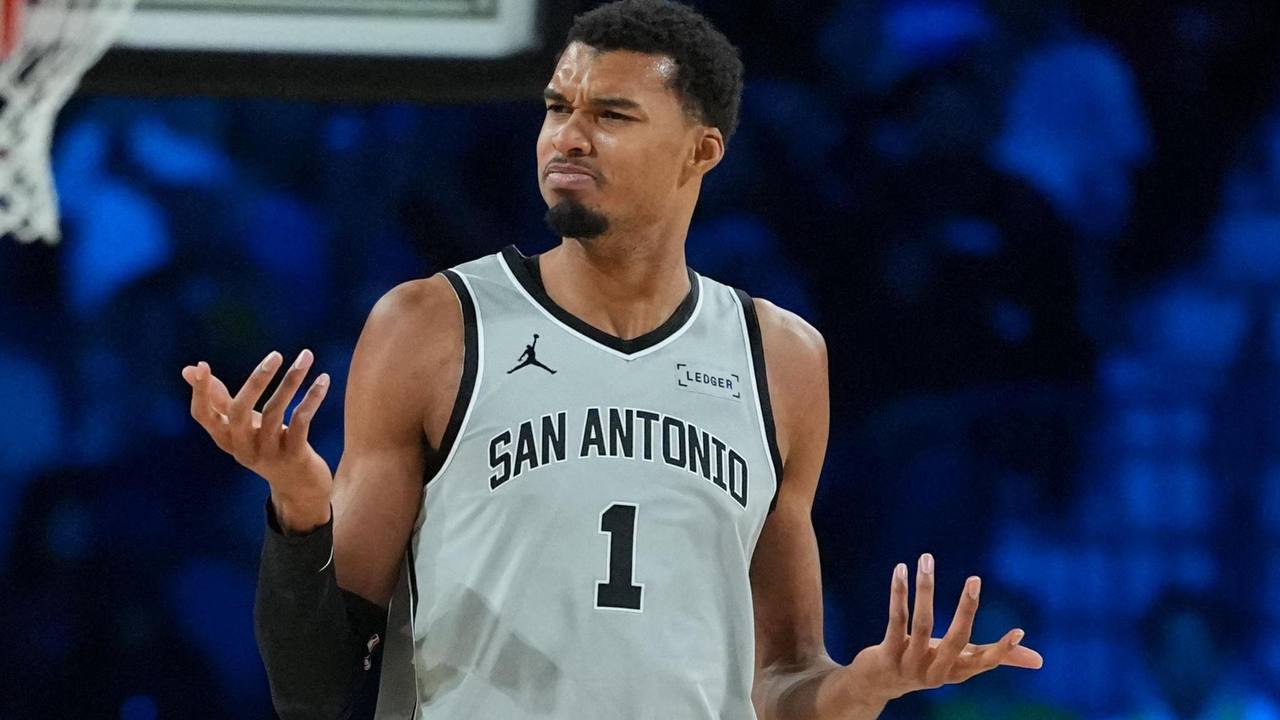
Victor Wembanyama may fall short in the MVP race this season, but framing that outcome as a disappointment misses the bigger picture. In reality, this moment could mark the beginning of something far more dangerous—for the rest of the NBA.
Over the past few weeks, momentum has clearly shifted away from Wembanyama in the MVP conversation. Media polls and player sentiment have leaned heavily toward other superstars, reinforcing the idea that his historic two-way dominance won’t be enough to secure the league’s top individual honor this year. And yet, even without the MVP trophy, his season has been nothing short of extraordinary.
At just a few years into his career, Wembanyama has already established himself as arguably the most impactful defensive player in basketball. A Defensive Player of the Year award feels inevitable, with All-NBA First Team and All-Defensive First Team honors likely to follow. For most players, that résumé would define a career year. For Wembanyama, it feels like a stepping stone.
What makes this situation especially intriguing is not what he’s accomplished—but how he might respond to falling short.
Great players don’t just chase recognition; they internalize slights, real or perceived, and use them as fuel. Wembanyama has already shown flashes of that edge. When challenged physically or verbally, he doesn’t shrink—he escalates. Opponents who test him often find themselves on the wrong end of a highlight play moments later.
Now imagine that same competitor entering an offseason with a clear message from the basketball world: what he’s doing isn’t enough.
That’s where the “silver lining” becomes a warning sign.
If the MVP criteria continue to prioritize scoring above all else, Wembanyama is more than capable of adapting. He’s already an efficient offensive force; adding higher scoring volume is less about ability and more about intent. And if he decides to chase points the way he currently chases blocks, the league could be dealing with a player who dominates both ends at an unprecedented level.
The idea of a 7’5” defender who alters every shot at the rim while also averaging 30+ points per game isn’t theoretical—it feels inevitable.
Beyond individual accolades, this shift could have major implications for team success. The Spurs are steadily building around him, and a more offensively aggressive Wembanyama would elevate their ceiling dramatically. Combine elite defense with superstar scoring, and you’re looking at the foundation of a championship contender.
There’s also a psychological layer to consider. Missing out on MVP—especially in a tightly contested race—can sharpen a player’s focus. It creates a narrative, a chip on the shoulder that carries into the next season. For someone already as driven as Wembanyama, that added motivation could unlock another level entirely.
And that’s the part the rest of the league should worry about.
Because while MVP awards are decided by voters, dominance is decided on the court. Wembanyama doesn’t need a trophy to validate his trajectory. If anything, being overlooked might accelerate it.
So yes, he may not win MVP this season. But if history has taught us anything about elite competitors, it’s that moments like this rarely slow them down.
They sharpen them.
And if that’s the case, the real story isn’t that Wembanyama lost the MVP.
It’s that everyone else might have just made him better.