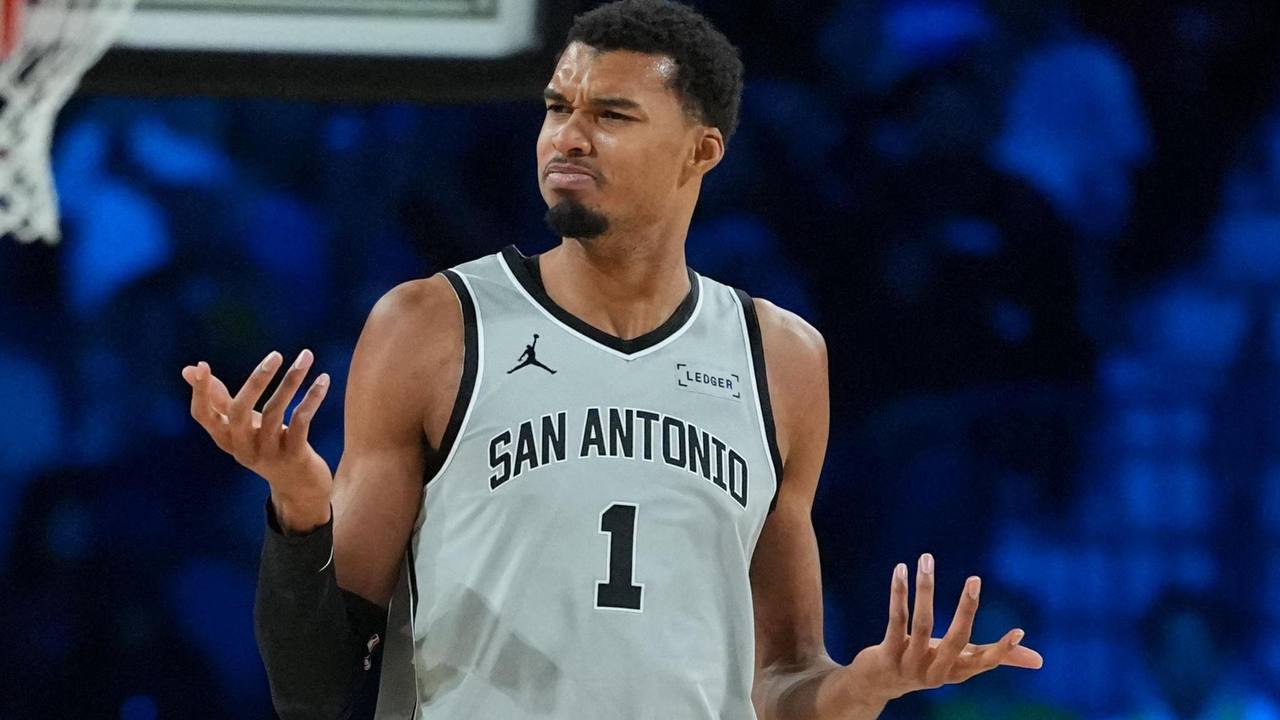
The rapid rise of Victor Wembanyama is beginning to feel less like potential and more like inevitability. In just his third season, the San Antonio Spurs star has not only elevated his team to the upper tier of the Western Conference but has also drawn comparisons to some of the greatest players in NBA history. Now, a new narrative is emerging — one that links his journey to that of Kareem Abdul-Jabbar and a select group of legendary champions.
At just 22 years old, Wembanyama has positioned himself as a leading contender for the MVP award while guiding the Spurs to a remarkable regular-season record. For a player so early in his career, the level of dominance he has displayed is rare, and history suggests that what comes next could be even more significant.
The comparison to Kareem Abdul-Jabbar is not just about individual brilliance — it’s about timing, trajectory, and impact. Abdul-Jabbar famously led the Milwaukee Bucks to an NBA championship in just his second season, establishing himself as one of the most dominant forces the league had ever seen. Wembanyama now finds himself on a similar path, albeit in his third year, with a team that has rapidly transformed into a legitimate title contender.
What makes this comparison even more compelling is the broader historical trend. Only a handful of teams in NBA history have managed to win a championship led by a star under the age of 24. Among them are Abdul-Jabbar’s 1971 Bucks, Bill Walton’s Portland Trail Blazers in 1977, and Larry Bird’s Boston Celtics in 1981. These teams share a striking similarity with the current Spurs squad — they all experienced struggles and missed the playoffs shortly before their championship breakthrough.
The Spurs appear to be following that exact blueprint. Not long ago, they were on the outside looking in, rebuilding and searching for direction. Now, with Wembanyama at the center, they have become one of the most exciting and dangerous teams in the league. His unique combination of size, skill, and basketball intelligence has allowed him to dominate both ends of the floor, redefining what is possible for a modern big man.
Adding to the intrigue is the level of support surrounding him. Guards like De’Aaron Fox and Stephon Castle have played crucial roles in complementing Wembanyama’s strengths, providing scoring, playmaking, and defensive balance. This supporting cast has helped accelerate the Spurs’ development, turning them from a rebuilding project into a genuine championship threat.
There is also growing belief within the league that the Spurs could go all the way. In a recent anonymous poll of NBA players, a significant portion backed Wembanyama’s team as potential champions, second only to the Oklahoma City Thunder. Interestingly, the Spurs have had the upper hand in recent matchups against the Thunder, winning four of their last five encounters — a detail that has not gone unnoticed.
Of course, history does not guarantee success, but it often provides a roadmap. The parallels between Wembanyama’s Spurs and past championship teams are difficult to ignore. From early-career dominance to rapid team progression, the signs are all there.
Still, the playoffs present a different challenge. Expectations are higher, pressure intensifies, and every weakness is exposed. For Wembanyama, this will be the ultimate test — an opportunity to prove that he is not just the future of the NBA, but its present.
As the postseason approaches, one question looms large: can Wembanyama follow in the footsteps of legends and deliver a championship this early in his career? If history is any indication, the answer might be closer than many expect.