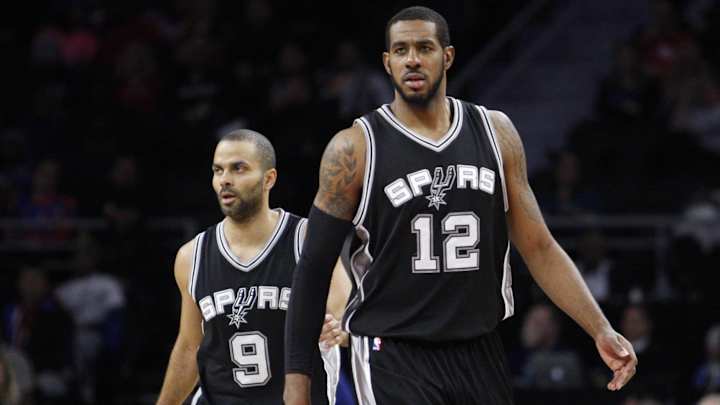
A fascinating Spurs comparison has sparked debate across NBA circles: could the 2016–17 San Antonio Spurs really stand up to the 2026 version of the franchise built around Victor Wembanyama?
Both teams represent different eras, different styles, and completely different basketball realities—but the comparison highlights just how much the game has changed in less than a decade.
Two Spurs eras, two completely different identities
The 2016–17 Spurs were one of the most polished and disciplined teams of their generation. Led by Kawhi Leonard and LaMarcus Aldridge, they combined elite defence with methodical half-court execution.
That roster also featured seasoned veterans like Tony Parker, Manu Ginóbili, Pau Gasol, Danny Green, Patty Mills, and David Lee—players who understood spacing, ball movement, and control of tempo at an elite level.
They were not flashy, but they were brutally efficient.
In contrast, the 2026 Spurs are built around pace, athleticism, and explosive offensive versatility. Victor Wembanyama is the undisputed centrepiece, supported by a new wave of talent including De’Aaron Fox, Stephon Castle, Devin Vassell, and Dylan Harper.
It’s a completely different basketball philosophy—faster, more dynamic, and far more perimeter-heavy.
The Kawhi Leonard problem
Any comparison between the two teams begins and ends with Kawhi Leonard.
In 2017, Leonard was already one of the league’s most dominant two-way forces, finishing second in MVP voting. His ability to control both ends of the floor would give any team in any era serious problems.
However, the modern Spurs arguably have more offensive firepower and depth across multiple positions. Their guard rotation alone presents matchup nightmares in transition and isolation.
Where Wembanyama changes everything
The biggest swing factor in this hypothetical matchup is Victor Wembanyama.
At 7-foot-4 with elite rim protection and perimeter skill, he represents a type of player the 2017 Spurs simply never had to prepare for. Even elite bigs like LaMarcus Aldridge and Pau Gasol would struggle to deal with his combination of size, mobility, and shot-blocking range.
On the flip side, Aldridge’s mid-range scoring and post craft would still be a major weapon against a more switch-heavy modern defence.
Style clash: control vs chaos
The 2017 Spurs excelled in structure, ball movement, and defensive discipline. They forced opponents into uncomfortable half-court possessions and punished mistakes.
The 2026 Spurs thrive in tempo, spacing, and athletic mismatches. They want speed, transition opportunities, and constant pressure on the rim and perimeter.
It becomes a question of whether experience and structure can slow down youth and explosiveness.
Final verdict: a modern edge
In a seven-game series, the balance likely tilts toward the 2026 Spurs. Their size, speed, and shot creation across multiple positions would create sustained pressure that even a disciplined 2017 unit would struggle to contain.
The 2017 team would certainly make it competitive—possibly stealing games through execution and defence—but over a full series, the modern era’s advantages become difficult to ignore.
It’s a hypothetical, of course—but one that highlights just how dramatically the NBA has evolved in less than ten years.