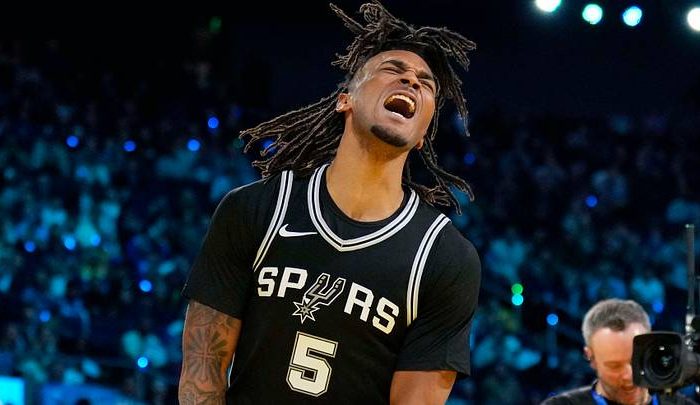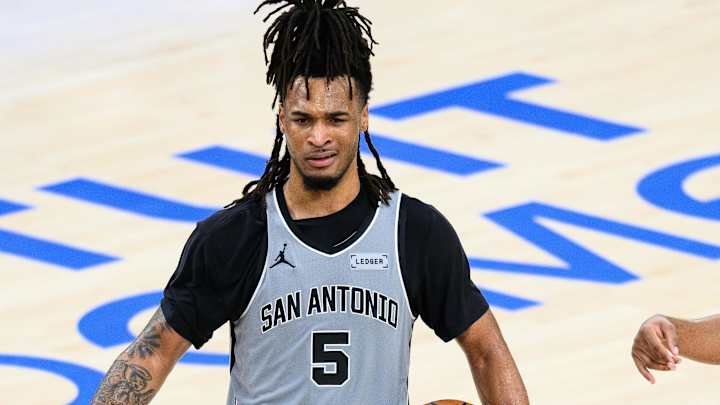
There’s a growing narrative around the San Antonio Spurs that is starting to look more outdated by the day — and it revolves around one label: non-shooters. For much of the season, young guards Stephon Castle and Dylan Harper were casually grouped into that category, lumped together with players whose offensive limitations were seen as clear weaknesses heading into high-pressure playoff basketball.
But that narrative is now being challenged in real time.
The idea of branding Castle and Harper as part of some “non-shooting generation” may have made sense earlier in their development, but recent performances suggest that label is quickly becoming irrelevant. Both players have shown significant improvement from beyond the arc, and more importantly, they’ve done it consistently enough to demand attention.
Since mid-February, the numbers tell a compelling story. Castle has been shooting around 42% from deep, while Harper has been even more efficient at approximately 48%. This isn’t a short hot streak that can be dismissed as a fluke — it’s sustained growth over a meaningful stretch of games. And for a Spurs team already anchored by the dominant presence of Victor Wembanyama, that development could completely change their offensive ceiling.
The timing couldn’t be more important.
As the Spurs head toward the postseason, the conversation should not be about hypothetical “legacy” debates or long-term labels. Instead, the focus needs to shift to the immediate impact these players can have. Playoff basketball is a different environment — defenses tighten, intensity rises, and weaknesses are exposed quickly. But it also rewards players who can adapt and rise to the moment.
That’s where Castle and Harper enter the equation.
There’s no guarantee their shooting percentages will remain at such elite levels once the playoffs begin. Historically, young players often face struggles under postseason pressure. The atmosphere, the pace, and the defensive attention can all disrupt rhythm. But the Spurs don’t need perfection — they need enough.
If Castle and Harper can maintain even high-30s efficiency from three-point range, it would be more than sufficient to stretch opposing defenses. And that’s where the real danger lies. With Wembanyama commanding constant double teams and defensive focus inside, any reliable perimeter shooting instantly becomes a weapon.
Spacing becomes cleaner. Passing lanes open up. Defensive schemes are forced to adjust.
In essence, the Spurs’ supposed weakness could turn into one of their biggest strengths.
This shift also reflects a broader issue with how young players are evaluated. Labels like “non-shooter” can stick quickly, but development isn’t static. Players evolve, adapt, and improve — and sometimes faster than expected. Castle and Harper appear to be doing exactly that, redefining their roles before the league has had time to fully adjust.
Ultimately, the biggest takeaway isn’t about rewriting legacies — it’s about recognizing what’s happening right now. The Spurs are not heading into the postseason with a flawed offensive core. Instead, they may be entering it with a rapidly improving backcourt that could catch opponents off guard.
And if that trend continues, the rest of the league might realize too late that the so-called “non-shooters” were never a weakness at all.