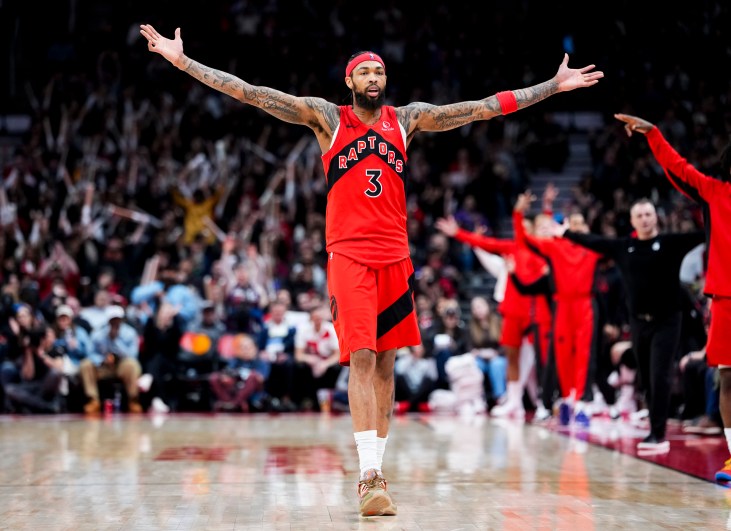
The Toronto Raptors’ long-awaited return to the playoffs didn’t go as planned, and Brandon Ingram didn’t shy away from addressing the issues after their Game 1 defeat to the Cleveland Cavaliers.
Toronto fell 126–113 on the road, a result that highlighted both the gap in execution and the challenges of postseason basketball. While the scoreline suggests a competitive outing, the flow of the game told a different story—particularly in the second half, where the Raptors struggled to generate consistent offense.
Ingram, playing in his first postseason with Toronto, finished with 17 points, four assists, and two rebounds on an efficient 5-of-9 shooting performance. However, the stat line didn’t reflect his limited involvement, especially after halftime.
The All-Star forward was candid in his postgame comments, pointing to his reduced role within the offense as a key issue.
“Coach wanted to use me as a screener,” Ingram explained. “He noticed that my man wasn’t coming off of me. He wanted me outside of the action a little bit of being a receiver… At the end of the day, me shooting nine shots is not gonna win a basketball game.”
His remarks underscored a broader concern for the Raptors: offensive identity. Against a well-organized Cavaliers defense, Toronto often looked stagnant in half-court sets, relying heavily on isolation plays and contested mid-range shots rather than fluid ball movement.
That lack of rhythm became more apparent as the game wore on. Ingram managed just four points in the second half and attempted only one field goal, a surprising drop-off for a player expected to carry a significant scoring load.
Despite the setback, the Raptors’ season remains a success story. After missing the playoffs in recent years, the team has re-established itself as a competitive force in the Eastern Conference. Ingram has been central to that resurgence, averaging over 21 points per game during the regular season while providing a reliable scoring presence.
But the playoffs present a different challenge.
Cleveland’s defensive discipline and ability to control tempo exposed areas Toronto will need to address quickly. If the Raptors hope to make this a competitive series, they must find ways to involve Ingram more effectively and create easier scoring opportunities.
There is still time to respond. Game 2 offers a chance to adjust before the series shifts to Toronto, where the Raptors will look to leverage home-court energy to regain momentum.
For Ingram, the path forward is clear. His performance—and more importantly, his usage—will be critical in determining how far this Raptors team can go. His honesty after Game 1 may be a sign of accountability, but it also highlights the urgency of change.
Because in the playoffs, adjustments aren’t optional—they’re necessary.