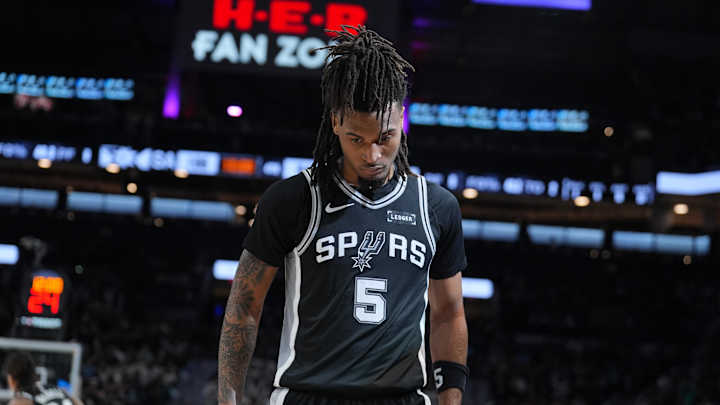
Stephon Castle’s playoff debut may have been impressive on the surface, but Game 1 also revealed a potential vulnerability the Portland Trail Blazers are already trying to exploit.
The San Antonio Spurs rookie guard delivered a solid all-around performance in his first postseason appearance, but his inconsistency from three-point range stood out as a tactical focal point for Portland’s defense.
A Targeted Defensive Game Plan
From the opening minutes, Portland made it clear they had identified a potential weakness.
The Blazers assigned seven-footer Donovan Clingan to Castle in certain defensive sets, a move designed to neutralize his driving lanes while daring him to shoot from the outside. The strategy worked early.
Clingan was able to stay anchored in help defense, sagging off Castle when he operated away from the ball and cutting off penetration when he tried to attack off the dribble. The result: hesitation, rushed decisions, and missed perimeter shots.
Castle finished just 1-of-5 from three-point range, and for stretches, Portland’s gamble paid off.
Spurs Adjust — and Castle Responds
As the game progressed, San Antonio adapted.
Mitch Johnson adjusted Castle’s role, using more off-ball movement and structured actions to free him up in space. Instead of forcing perimeter shots, the Spurs leaned into his ability to attack downhill and create plays inside the arc.
The shift worked.
Castle found rhythm, finishing with 17 points and 7 assists, showing maturity beyond his years by impacting the game even when his shot wasn’t falling.
Why the Three-Point Shot Still Matters
Despite his solid overall performance, Castle’s shooting remains a key storyline for the series.
San Antonio’s offensive system relies heavily on spacing, and Castle becoming a consistent threat from deep would unlock another level for the Spurs attack. Without it, opposing teams will continue to collapse into the paint and limit driving opportunities.
Portland’s approach in Game 1 may just be the beginning.
Expect other teams to take notice.
Signs of Long-Term Growth
There is, however, a reason for optimism in San Antonio.
Castle has already shown he can improve quickly within a single season. After the All-Star break, he shot close to 40% from three-point range, proving that his perimeter game is developing.
That stretch suggests his struggles are not structural—but situational.
And for a rookie in his first playoff series, inconsistency is expected.
No Panic in San Antonio
Inside the Spurs camp, there is no concern about Castle’s performance.
The belief is simple: his growth trajectory is steep, and his ability to adapt mid-game is already evident. The foundation is there—now it’s about translating it consistently on the biggest stage.
If he does, the Blazers’ defensive plan quickly becomes obsolete.
A Learning Curve on the Biggest Stage
Game 1 served as both an introduction and a warning.
Castle is already good enough to impact playoff games—but not yet complete enough to be ignored by opposing scouting reports.
The Blazers have shown the blueprint. Now the question is whether Castle can dismantle it as the series progresses.
If his post-All-Star shooting form is any indication, the answer might come sooner than expected.