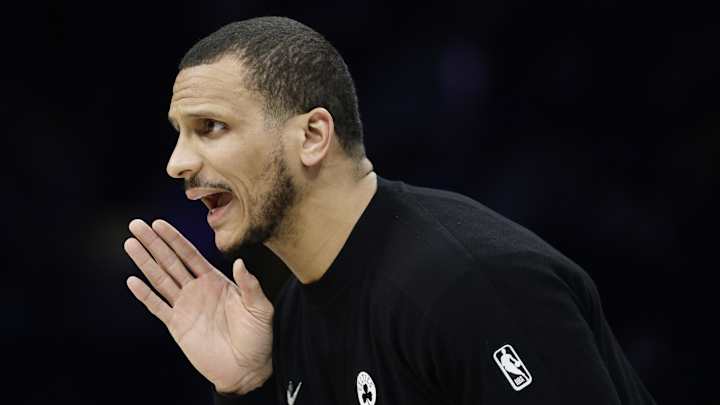
The Boston Celtics may have dropped Game 2 against the Philadelphia 76ers, but their defensive identity and overall game plan remain unchanged as the series shifts back into a pivotal stretch.
Despite a 111–97 setback at TD Garden, Boston’s coaching staff and players continue to believe their approach—forcing the 76ers into tough perimeter-heavy looks—is still the correct formula for winning the rivalry matchup.
The message from inside the Celtics locker room is clear: the strategy is not the problem. Execution is.
Defensive plan remains unchanged
Throughout the series, Boston has made its intentions obvious. The goal is to limit Philadelphia’s efficiency at the rim while encouraging jump shots, particularly from a team that ranked among the league’s weaker three-point shooting units during the regular season.
The 76ers shot just 34.9% from beyond the arc during the year, reinforcing Boston’s belief that living with perimeter attempts is preferable to allowing consistent interior scoring.
That approach was highly effective in Game 1, where Boston’s defensive structure was disciplined, connected, and suffocating, leading to a dominant win.
However, Game 2 told a different story—not because the plan changed, but because its execution slipped.
Tyrese Maxey exposes defensive lapses
Much of Philadelphia’s offensive success in Game 2 came through Tyrese Maxey, who punished small breakdowns in Boston’s perimeter containment.
Maxey, dealing with lingering issues following a finger injury, still managed to hit five three-pointers, often capitalizing on moments when Boston’s drop coverage was slow to rotate or when he was allowed clean driving angles to his strong hand.
Those same looks were largely absent in Game 1, where Boston limited him to 1-of-4 from deep and forced tougher shot selection overall.
The difference, according to observers, was not schematic—it was discipline and timing within the scheme.
Interior control still a key Celtics strength
Even in defeat, Boston’s defensive structure inside the paint remained relatively effective.
Philadelphia, which thrives on rim pressure, was held below its usual efficiency in the restricted area compared to regular-season averages. While the 76ers still generated opportunities close to the basket, Boston’s size and length made those attempts more contested than comfortable.
That balance—protecting the rim while conceding perimeter volume—is at the core of Boston’s playoff identity.
No panic inside Celtics camp
Veteran presence in the locker room has helped steady the response to Game 2. The sentiment is not one of frustration with the system, but rather an acknowledgment that small lapses in execution can swing playoff games.
The Celtics have emphasized communication, spacing discipline, and collective defensive responsibility as the deciding factors moving forward.
As one veteran voice highlighted, Boston’s defense works best when all five players operate in sync, rather than relying on individual stops.
What must change in Game 3
Heading into the next game, the Celtics are not expected to overhaul their defensive approach. Instead, the focus will be on tightening rotations, improving ball pressure at the point of attack, and reducing the clean catch-and-shoot opportunities that Philadelphia capitalized on in Game 2.
The philosophy remains consistent: live with difficult jump shots, eliminate easy finishes, and trust defensive structure over reactionary adjustments.
Series outlook
With the series now tightened, Game 3 becomes a critical moment for momentum.
Boston still believes its blueprint is sound—and if execution returns to the level shown in Game 1, the Celtics are confident they can regain control of the matchup.
In a rivalry defined by adjustments and counter-adjustments, Boston’s message is simple: the plan works. Now it’s about proving it again on the floor.