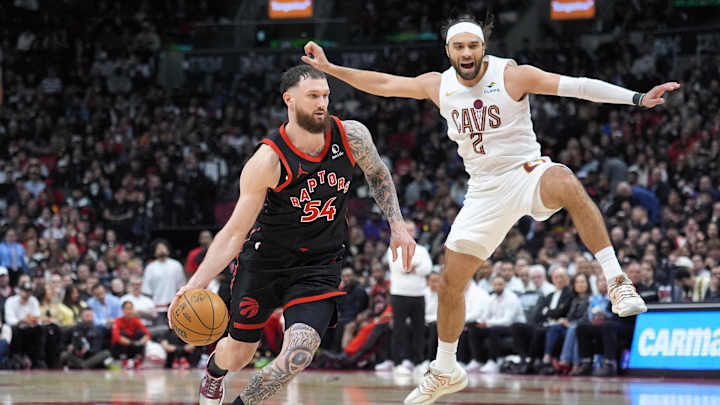
The Toronto Raptors didn’t just play harder in Game 3—they played smarter. After looking disjointed early in the series against the Cleveland Cavaliers, Toronto responded with a performance built on intentional changes, not desperation. The result was a far more cohesive team effort that revealed what this group is capable of when structure meets execution.
A Lineup Shift That Set the Tone
One of the most impactful moves came before the opening tip. Swapping Jamal Shead for Ja’Kobe Walter in the starting lineup wasn’t about scoring—it was about balance.
Walter’s offensive struggles didn’t define his night. Instead, his defensive presence helped contain elite perimeter threats like Donovan Mitchell and James Harden. He stayed disciplined, contested shots, and—just as importantly—forced Cleveland to respect him as a shooter. Even without hitting shots, his spacing kept defenders honest, opening lanes for teammates.
This is the kind of adjustment that doesn’t dominate highlight reels but quietly reshapes the game.
Bench Boost: Instant Impact from Deep
Toronto’s rotation tweak paid off immediately with Jamison Battle delivering a near-perfect shooting performance. His 14 points—all fueled by four made threes—gave the Raptors a dimension they’d been missing.
Battle’s presence stretched Cleveland’s defense, preventing them from collapsing into the paint. That ripple effect created cleaner looks across the board and made Toronto’s offense feel far less congested. It wasn’t just about the points—it was about the spacing his shooting unlocked.
Star Duo Finds Offensive Harmony
For the first time in the series, the Raptors’ offense had rhythm—and it started with Scottie Barnes and RJ Barrett.
Both players dropped 33 points, but more importantly, they did it within the flow of the game. Barnes attacked from multiple angles, mixing drives with mid-range efficiency, while Barrett applied constant pressure with decisive scoring.
Instead of trading isolated scoring bursts, the duo operated in sync. That consistency gave Toronto a reliable offensive backbone, something that had been missing in earlier games.
Spacing: The Hidden Game-Changer
The Raptors’ improved spacing was the glue that held everything together. With more credible shooters on the floor, Cleveland couldn’t crowd the paint or force rushed decisions.
This led to:
- Cleaner driving lanes
- Better shot selection
- Fewer forced passes
Spacing doesn’t show up in the box score, but its impact was obvious. Toronto’s offense looked fluid, confident, and under control.
Composure Over Chaos
Perhaps the most underrated improvement was decision-making. The Raptors cut down on careless turnovers and avoided the rushed possessions that plagued them earlier in the series.
This wasn’t accidental—it was structural. Players were put into roles that made sense, and that clarity translated into smarter basketball. The ball moved with purpose, and possessions ended with quality looks rather than desperation heaves.
A Blueprint, Not a Fluke
Game 3 wasn’t just a bounce-back win—it was a proof of concept.
Toronto showed that with:
- A balanced lineup
- Strategic rotation choices
- Reliable spacing
- Controlled execution
—they can compete at a much higher level.
The question now isn’t whether these adjustments work. It’s whether the Raptors can sustain them.
Final Word
This wasn’t about talent suddenly appearing—it was about alignment. The Toronto Raptors finally put the right pieces in the right places, and everything clicked.
If they maintain this formula, the series against the Cleveland Cavaliers could take a dramatic turn. Because sometimes, the difference between struggling and thriving isn’t effort—it’s clarity.