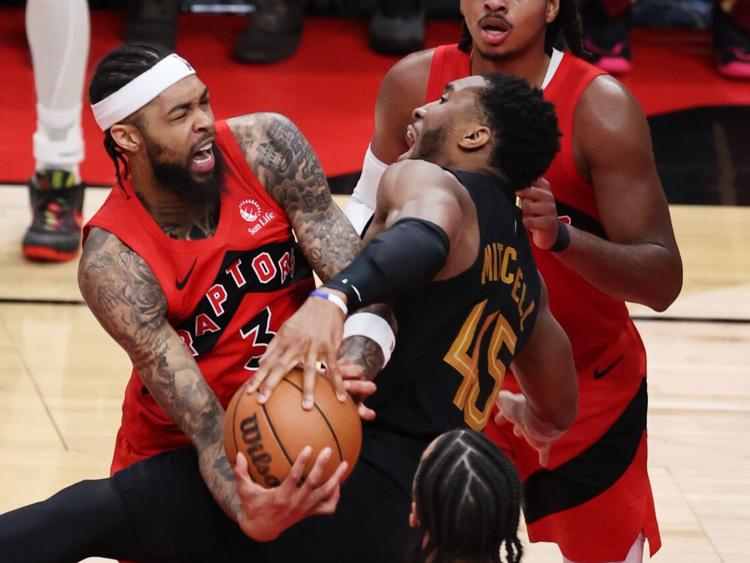
The Toronto Raptors’ postseason run came to an end in Game 7 against the Cleveland Cavaliers, with injuries and roster limitations ultimately proving too much to overcome in a hostile road environment.
With both Brandon Ingram and Immanuel Quickley unavailable, Toronto entered the decisive matchup severely undermanned, forced to rely heavily on role players in one of the most demanding scenarios in basketball.
As analyst Zach Lowe noted on The Bill Simmons Podcast, the challenge facing Toronto was less about effort and more about structural limitations.
Missing stars prove decisive in Game 7
The absence of Brandon Ingram in particular left a major void in Toronto’s offensive structure. Even when not at his best during the series, Ingram’s presence still altered defensive schemes and created spacing advantages for teammates.
Without him, Cleveland was able to tighten its focus on Scottie Barnes and RJ Barrett, effectively simplifying its defensive responsibilities. Barrett struggled to find consistent rhythm, finishing inefficiently as the Cavaliers controlled key stretches of the game.
Lowe emphasized that while Ingram’s series production may not have been dominant, his absence removed a layer of offensive threat that cannot be easily replaced in a Game 7 setting.
Role players pushed beyond their limits
Toronto’s supporting cast—players like Jamal Shead, Jamison Battle, and others—were forced into expanded roles throughout the series. While several delivered impactful moments, including timely shooting and defensive plays in earlier games, sustaining that production over a full elimination game proved unrealistic.
Shead in particular provided energy and defensive activity, stepping up during stretches where Toronto needed urgency. Battle also contributed key perimeter shooting in earlier wins that helped extend the series.
However, as Lowe pointed out, expecting such players—many still early in their NBA careers or established as rotational pieces—to carry a Game 7 against a more experienced Cavaliers core was an extremely difficult ask.
Cleveland’s experience gap shows
The Cavaliers entered Game 7 with multiple players who had previously experienced All-Star level success, giving them a clear advantage in composure and execution under pressure.
That gap became increasingly apparent as the game progressed, with Cleveland able to control tempo and exploit mismatches more effectively as Toronto’s offense stagnated.
Raptors left reflecting on what might have been
Head coach Darko Rajaković acknowledged the difficulty of the situation postgame, avoiding excuses while recognizing the challenge of competing without key contributors.
The Raptors’ effort was not in question, but the absence of their full offensive core ultimately shifted the balance too far in Cleveland’s favor.
As the series concluded, one theme stood out clearly: Toronto’s margin for error had already disappeared before the opening tip of Game 7.
While the role players showed flashes of potential throughout the postseason, the series underscored a broader reality—depth can sustain you in stretches, but in elimination games, star power remains the defining factor.