“
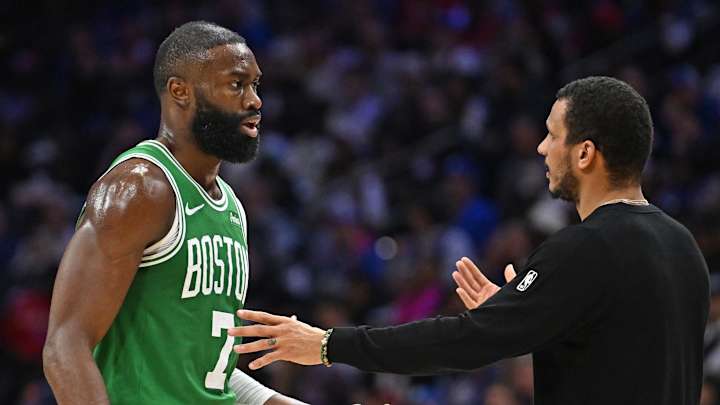
The Boston Celtics entered the season with expectations so low they barely existed.
Talk of a “gap year” floated around the franchise early on — a transitional season, a roster not quite built to contend, and a coaching staff trying to stitch together a competitive identity from uncertainty. The early narrative suggested Boston might drift, maybe scrape into the playoffs, and possibly steal a round if things broke right.
Instead, they did something far more disruptive: they turned confusion into momentum.
They didn’t just compete — they overperformed. They climbed from early-season inconsistency into a legitimate contender, forcing the league to reassess what this team actually was. Night after night, they beat expectations instead of meeting them.
What started as a “rebuild year” slowly transformed into something far more dangerous: belief.
The Rise Nobody Fully Saw Coming
As the season unfolded, Boston stopped looking like a placeholder team.
They became one of the league’s most unpredictable problems. Wins piled up against higher-seeded opponents, role players emerged as legitimate contributors, and the roster’s depth turned into a nightly advantage rather than a question mark.
A key part of the transformation was how different players stepped into expanded roles. Some developed into reliable rotation pieces, others became surprise impact contributors, and the team’s chemistry shifted from experimental to functional — even dangerous.
Every win didn’t just improve their record; it reshaped expectations in real time.
By midseason, the “gap year” label didn’t fit anymore. It had evolved into something louder: “What if this team is actually good?”
The Playoff Run That Changed the Mood — Then Broke It
That momentum carried into the postseason, where Boston looked fully capable of punching beyond its original weight class.
For a stretch, they controlled their series and appeared to have the upper hand. A 3–1 lead turned the conversation from “surprise team” to “potential conference threat.”
Then it all unraveled.
The final three games flipped the narrative completely. What looked like a breakthrough turned into a collapse, and what felt like a statement season ended in frustration and disbelief.
Criticism followed immediately — and fairly so. Closing out a series from that position is exactly what championship-caliber teams are supposed to do. Boston didn’t.
But even with the disappointment, the larger picture didn’t disappear.
Why This Season Still Isn’t a Failure
What makes this Celtics season complicated is that both realities exist at once.
Yes — they fell short when it mattered most. Yes — they let a winnable series slip away. And yes — that will linger far longer than any regular-season success.
But the foundation they built is real.
This wasn’t a team treading water. It was a team discovering itself under pressure, testing combinations, identifying long-term pieces, and learning exactly how far its current structure can stretch.
That matters in a way the final series alone can’t erase.
Because seasons aren’t only defined by endings — they’re defined by what they reveal.
The Bigger Picture Going Forward
Now the Celtics enter the offseason with clarity they didn’t have a year ago.
They know which players can handle pressure, which lineups hold up under intensity, and where the roster still needs reinforcement. They also know the standard has shifted — expectations are no longer about “being competitive,” but about finishing the job.
That’s the paradox of this season.
It was both a breakthrough and a breakdown.
A campaign that started as a “gap year” ended as a harsh reminder of how thin the line is between progress and pain in the NBA.
And yet, even with the heartbreak, Boston didn’t waste the year.
They just didn’t finish it the way they wanted.