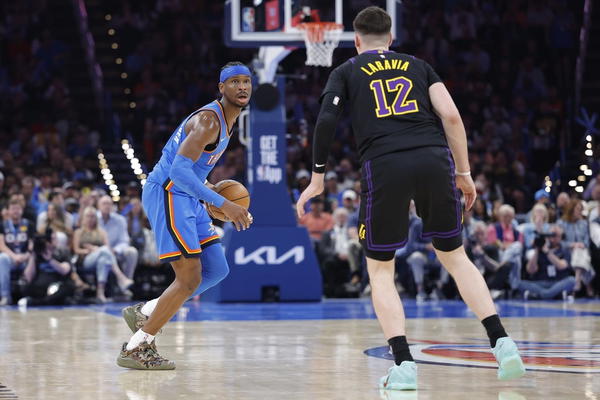
The Oklahoma City Thunder enter their second-round clash with the Los Angeles Lakers knowing one uncomfortable truth: talent alone won’t end this series quickly. Experience, playoff resilience, and star power still sit heavily on the Lakers’ side of the table, meaning OKC will need to actively take control rather than wait for it.
If the Thunder want a short series instead of a drawn-out battle, the formula is simple in theory—but ruthless in execution.
Pace is the weapon that changes everything
Oklahoma City’s biggest advantage is also their clearest identity: speed.
The Thunder are built to run, and against an older Lakers roster, that becomes more than a style—it becomes a strategy designed to break legs and shorten rotations. Every rebound, turnover, and even made basket is an opportunity to push the ball.
The goal is not just to score quickly, but to force Los Angeles into constant transition defense, possession after possession, until fatigue starts to show in late-game execution.
That is how short series are created: not with one blowout, but with accumulated exhaustion.
Shai Gilgeous-Alexander as the control switch
Everything begins with Shai Gilgeous-Alexander dictating tempo.
The Thunder don’t need him to rush. They need him to recognize early advantages and attack before the Lakers can settle into half-court structure. When he consistently gets downhill, the entire OKC offense expands—free throws increase, rotations break down, and open shooters emerge naturally.
If he controls the paint touches, Oklahoma City controls the series rhythm.
Making LeBron work on both ends
Even at this stage of his career, LeBron James remains a problem no team can ignore. But the Thunder’s advantage lies in volume—forcing him into repeated defensive actions.
Pick-and-roll coverage. Switches. Closeouts. Recovery efforts.
The idea isn’t to “stop” him. It’s to drain him.
If James is forced to spend energy on defense every possession, it changes how explosive he can be offensively in key stretches. That subtle wear-down effect is exactly how young teams tilt playoff series.
Discipline that avoids gifting momentum
One of the fastest ways to extend a series is through avoidable mistakes.
The Lakers are experts at slowing games down, drawing contact, and turning possessions into free-throw battles. Oklahoma City must resist that trap.
No unnecessary reaches. No late-clock fouls. No breakdowns that send Los Angeles to the line for free points.
If the Thunder keep their defense clean and structured, they preserve both pace and emotional control of the game.
Chet Holmgren’s two-way impact could define the series
Chet Holmgren is quietly one of the most important figures in this matchup.
Defensively, his rim protection gives OKC a safety net that discourages drives. Offensively, his spacing pulls bigs away from the paint, opening lanes for guards like Gilgeous-Alexander.
If he avoids foul trouble and remains active on both ends, the Lakers are forced into uncomfortable decisions—either challenge him inside or stretch their defense beyond its comfort zone.
Either outcome favors Oklahoma City.
Depth is where the series can break open
Few teams in the league can match the Thunder’s rotational energy.
Oklahoma City can sustain pressure across 48 minutes with fresh legs, constant defensive intensity, and uninterrupted pace. That depth becomes even more valuable in the playoffs, where star players are heavily targeted and bench minutes often decide momentum swings.
If OKC consistently wins those “non-star” minutes, the Lakers will find themselves fighting uphill all series long.
The final key: kill confidence early
Veteran teams thrive on belief. Once the Lakers feel a series is within reach, they become far more dangerous.
That’s why Oklahoma City’s most important task is psychological as much as tactical: establish control early and refuse to let go.
If the Thunder dictate pace, stay disciplined, maximize depth, and let their stars set the tone, they don’t just have a path to winning the series—they have a path to ending it quickly.