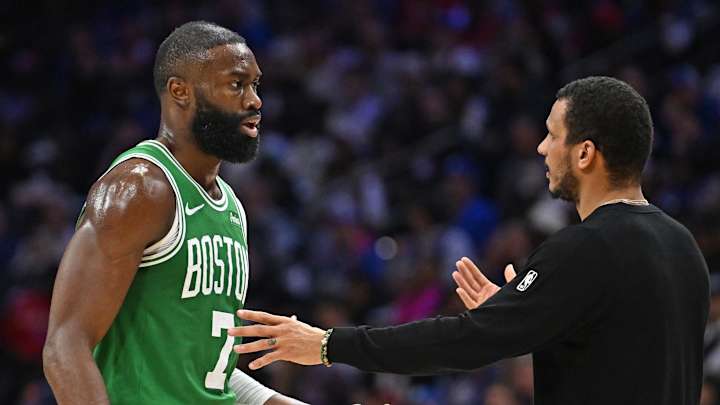
Jaylen Brown is undeniably an elite talent. However, following the Boston Celtics’ stunning Game 7 collapse against the Philadelphia 76ers—where the team squandered a 3-1 series lead for the first time in franchise history—Brown has traded his jersey for a “victim card.”
On a live Twitch stream just 24 hours after the season-ending loss, Brown doubled down on claims of an officiating “agenda,” specifically targeting the 10 offensive fouls called against him during the series. While Brown insists he is being unfairly singled out for moves “every good player does,” the data suggests otherwise.
The “Agenda” vs. Reality
Brown’s primary grievance centers on his use of the off-arm to create space, a maneuver he claims officials have explicitly told him they are looking to whistle.
- The Foul: Brown’s “bully” style of play relies heavily on a stiff-arm push-off. While many stars use this, Brown’s lack of fluid movement makes the contact more “obvious” to refs compared to shiftier players like Shai Gilgeous-Alexander.
- The Numbers: During the regular season, Brown was called for 40 offensive fouls in 71 games—roughly one every two games. If anything, he gets away with the move more often than he is caught.
- Whistle Respect: Despite his claims of being “disrespected,” Brown received a shooting foul whistle on 15% of his possessions this year—a higher rate than LeBron James, Stephen Curry, and Nikola Jokic.
Disrespect or Insecurity?
Throughout the 2025-26 season, Brown has run what looks like a self-promotion campaign. From tweeting that he is the “best two-way player in the game” to his bizarre claim in March that he is the “best human player” (conceding only that Victor Wembanyama is an alien), Brown seems fixated on external validation.
This fixation became tone-deaf when Jayson Tatum returned from his Achilles rehab. While Tatum is widely viewed as Boston’s 1A, Brown’s public declarations of being the world’s best essentially crowned himself over his own teammate.
The “Minus-57” Problem
For a player demanding superstar respect, the on-court impact during the Philly series was historically poor. In the Celtics’ final three losses of the first round:
- Net Impact: Brown was a combined minus-57 over those three games.
- The Bench Factor: The Celtics were actually plus-26 when Brown was on the bench during that same span.
- Historical Context: Even during Boston’s 2024 championship run, the team was statistically worse (minus-13.8 per 100 possessions) with Brown on the floor during the playoffs.
A Season of Contradictions
Perhaps the most confusing takeaway from Brown’s Twitch stream was his claim that this season—which ended in a first-round exit—was his “favorite year” of his career.
While Brown defended this by citing the adversity the team faced without Tatum, critics point out the timing: this was a year where Brown was the clear focal point and “alpha.” To many, it sounds like Brown enjoyed the individual spotlight of a losing season more than the secondary role he played in a championship season.
The Verdict
Jaylen Brown is a smart, talented, and essential piece of the Celtics’ future. But until he stops chasing officiating conspiracies and “best in the world” hashtags, the “crybaby” label from fans and analysts likely isn’t going anywhere. Respect in the NBA is earned through wins and efficiency, not Twitch rants and plus-minus stats that suggest your team is better off when you’re sitting.
Stat Check: Despite his complaints about Joel Embiid “flopping,” Brown admitted on stream that the 76ers big man was “unstoppable” and one of the best in history—right before suggesting the refs need to be investigated.