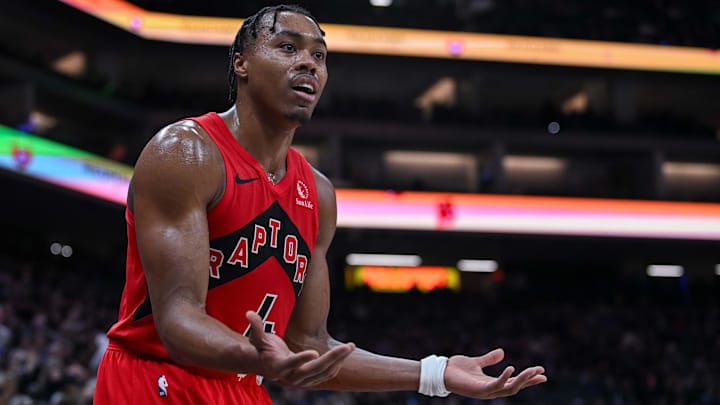
The Toronto Raptors front office has successfully assembled a gritty, high-potential young core. However, in doing so, they have inadvertently manufactured a roster-building nightmare for their 24-year-old franchise cornerstone, Scottie Barnes.
Barnes is undeniably phenomenal, but Toronto is currently testing the absolute limits of his gravity—asking him to bridge structural gaps that no single NBA superstar can realistically sustain.
Asking One Man to Be a System
In traditional roster construction, a superstar excels in a few elite categories while specialized role players mask their flaws. The Raptors have completely inverted this principle. Instead of building around Barnes, they are relying on him to be the ultimate band-aid for their roster’s biggest vulnerabilities:
- Playmaking & Point-Forward Duties: Serving as the primary engine of the offense.
- Perimeter Defense: Guarding the opposing team’s best perimeter threat on a nightly basis.
- Rim Protection & Rebounding: Forced to act as an emergency center and interior anchor due to the striking decline of Jakob Poeltl.
Expecting a player to physically cover that much ground across an 82-game season without burning out or risking injury is a Herculean task—and the physical toll was glaringly evident during Toronto’s recent playoff run against the Cleveland Cavaliers.
The Clunky Roster Paradox
The awkward fit of Toronto’s current core presents a tactical trap for head coach Darko Rajaković. While RJ Barrett put together some great playoff moments, the pairing of Barnes alongside Barrett and Brandon Ingram (who missed the final stretch of the postseason) has created a high-usage logjam.
If Barnes hunts his own shot, the chemistry with Ingram plummets. But if the front office merely asks a talent like Ingram to stand in the corner as a floor spacer, the massive investment made to acquire him is rendered completely useless. Conversely, if Barnes steps back into a purely selfless, facilitating role to make life easier for his teammates, Toronto loses the elite scoring upside that makes him an alpha.
Despite promising young perimeter threats like Immanuel Quickley and Ja’Kobe Walter, the roster simply lacks the specialized spacing required to let Barnes balance both roles naturally.
“Point-Forward-Center” is a Dream, Not a Strategy
Barnes has openly embraced his versatility in the past, acknowledging he can fill every void. However, he has also dropped hints about his preferences, previously noting he functions best next to true internal anchors who actually fulfill those baseline duties—even if the fit with Poeltl has seemingly run its course.
The bright side? Toronto’s front office has shown they still possess a sharp eye for emerging talent. The immediate success of 2025 draft pick Collin Murray-Boyles proves there is a viable blueprint forward.
If the Raptors want to see the absolute best version of Scottie Barnes during the 2026-27 campaign, the front office must stop using him to mask a clunky roster structure. It is time to make smart, specialized investments this summer, before their foundational superstar fractures under the weight of doing everything himself.
THE SCOTTIE BARNES BURDEN
- The Roles: Point guard, primary wing defender, emergency rim protector.
- The Risk: Extreme burnout or injury from covering too many structural flaws.
- The Roster Clunk: Overlapping usage with Brandon Ingram and RJ Barrett.
- The Silver Lining: Growth of young pieces like Collin Murray-Boyles, IQ, and Ja’Kobe Walter.