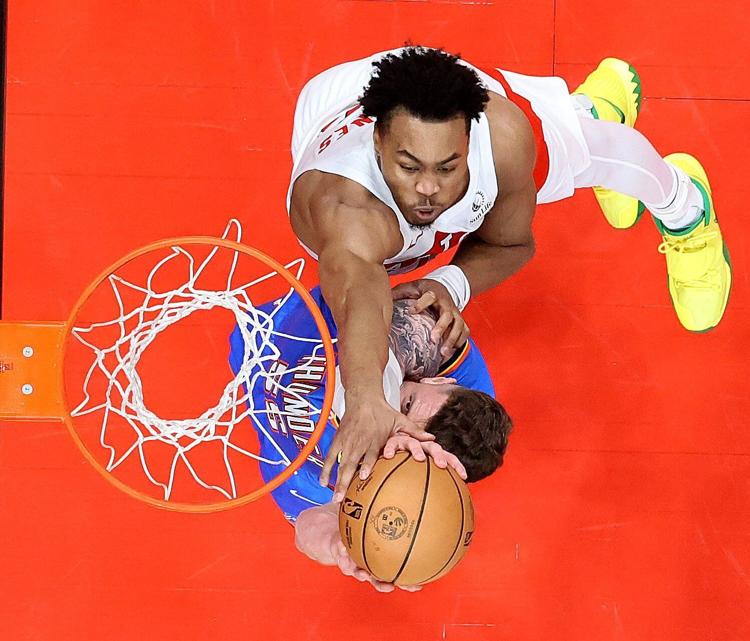
The official release of the 2026 NBA All-Defensive Teams has ignited a fierce, league-wide controversy. While Toronto Raptors fans fully expected their franchise cornerstone, Scottie Barnes, to firmly anchor the All-Defensive First Team, the voting panel delivered a shocking, razor-thin rejection that left the 24-year-old superstar completely left out in the cold.
The voting margin was a brutal, direct sting to the organization: Barnes finished with the sixth-most voting points overall, missing out on the final First Team slot by a razor-thin 16 points.
While external critics are pointing directly to a subtle statistical drop-off during the final stretch of the regular season, a deeper look into Toronto’s roster architecture exposes a much harsher truth—the front office simply broke their franchise star by forcing him to carry an impossible structural burden.
The Statistical Collapse Sparked by Chaos
On paper, Barnes was a defensive terror for the vast majority of the 2025/26 campaign. However, his elite trajectory hit an abrupt, visible wall on March 1st.
Voters heavily weighed the final two months of the season, where Barnes’ structural impact slightly waned. But this decline was entirely a byproduct of an emergency tactical crisis. When starting point guard Immanuel Quickley went down with nagging injuries, head coach Darko Rajakovic had no choice but to throw Barnes into the fire as the primary offensive facilitator while simultaneously demanding he remain the team’s defensive savior.
The increased playmaking exhaustion completely sapped his defensive counting stats. Barnes went from tracking a ferocious 3.0 stocks (steals + blocks) per game prior to March 1st down to 2.6 stocks over the final quarter of the season. Asking a single forward to serve as the absolute fulcrum at the point of attack on one end while operating as the primary engine on the other proved to be an unfair, catastrophic demand.
Breaking the Historic Monolith
Had Barnes secured those extra 16 voting points, he would have cemented his legacy as the first player in Toronto Raptors history to ever earn an All-Defensive First Team nod. Instead, he joins a highly exclusive, frustrated club of elite defenders who were ultimately penalized by voters for their team’s depth deficiencies.
The All-Defensive First Team layout instead went to structural specialists who weren’t asked to run an entire offense:
- Victor Wembanyama (San Antonio Spurs)
- Chet Holmgren (Oklahoma City Thunder)
- Ausar Thompson (Detroit Pistons)
- Rudy Gobert (Minnesota Timberwolves)
- Derrick White (Boston Celtics — edged Barnes by 16 points)
The Mandatory Blueprint Move for 2027
This award snub serves as an urgent, loud warning for the Raptors’ front office heading into the summer. Barnes essentially succeeded in keeping Toronto structurally afloat during a chaotic, injury-riddled stretch, but it cost him individual accolades and historic validation.
Rushing Barnes back into a multi-role overload next season without adequate backcourt insurance is no longer an option. If the Raptors want their franchise centerpiece to capture the defensive trophies he rightfully deserves, they must build a roster that allows him to dominate on defense without burning out at the opposite baseline.