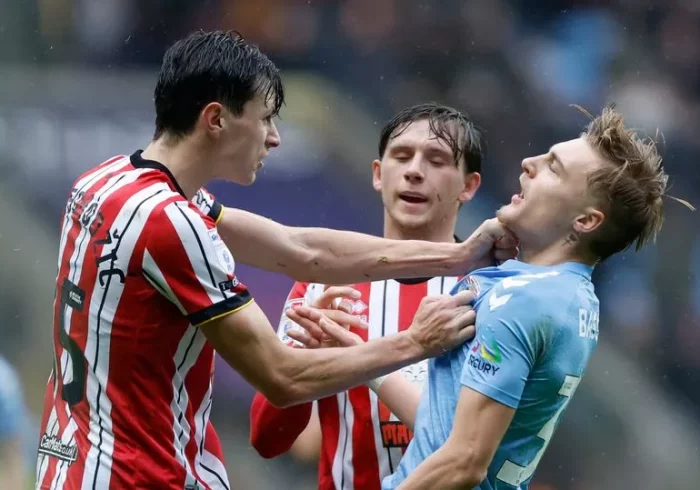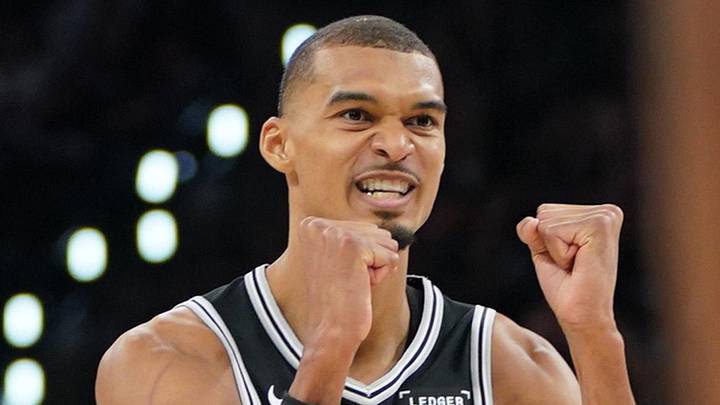
For the entire 2025-26 NBA season, the rest of the league had a singular, aggressive strategy for dealing with Victor Wembanyama: punish him. Opponents across the association realized that the easiest way to slow down “The Alien” was to abandon finesse and turn every possession into a physical war. They leaned on him, elbowed him, and forced him to fight through relentless contact until fatigue took its toll. While Wembanyama displayed incredible resilience, the wear and tear was undeniable.
But after a tactical masterpiece of a draft night, the San Antonio Spurs have officially changed the temperature of the room. By securing Kentucky’s frontcourt beast Jayden Quaintance and trading back into the first round to land UConn’s “gritty” enforcer Tarris Reed Jr., San Antonio has sent a clear message to the rest of the NBA: the days of bullying Victor Wembanyama are over.
The End of the “Bully Ball” Strategy
The formula used against Wembanyama last season was transparent. Opposing teams treated the 7’4″ phenom as a punching bag, knowing that if they were aggressive enough, the referees would often swallow their whistles. It was a strategy born of desperation, designed to irritate and exhaust him.
The Spurs clearly saw the impact this had on their franchise cornerstone. Teammates like Devin Vassell and Stephon Castle have hinted throughout the offseason that the team needed more muscle to protect their star. They needed players who didn’t just understand the game, but who embraced the “dirty work”—the kind of players who refuse to let their teammates be shoved around without consequence. With the additions of Quaintance and Reed Jr., the Spurs haven’t just added talent; they’ve added a combined 12 fouls worth of sheer, unadulterated muscle.
Meet the New Enforcers
Tarris Reed Jr. is the exact type of player Spurs fans have been craving. Having battled through a grueling championship run at UConn, Reed describes his style as “ugly and gritty.” He thrives in the trenches, playing with a level of ferocity that the Spurs lacked last year.
Alongside Quaintance, these two rookies aren’t just here to fill minutes—they are here to set a tone. The expectation is simple: if an opponent tries to target Wembanyama, they should expect to pay a heavy price on the other end of the court. This “protection squad” provides Wembanyama with a massive cushion, allowing him to focus on his offensive bag rather than constantly checking his ribs for bruises.
Why the League’s “Wemby Puzzle” Just Became Impossible
The traditional defensive approach to stopping Wembanyama—roughing him up—is now fundamentally broken.
First, consider the man himself. Wembanyama isn’t sitting idle this summer; he is already working on building a stronger core and more functional muscle. When he returns to the court, he will be a more polished, physically imposing version of the player who already terrorized defenses.
Second, the defensive landscape has shifted. Opponents no longer just have to worry about surviving four quarters against Wembanyama. Now, they must navigate a rotation that features Wemby, Luke Kornet, Quaintance, and Reed Jr. That is an unprecedented amount of size and physicality. If a team tries to play “bully ball,” the Spurs now have the roster depth to return that punishment with interest.
San Antonio has successfully eliminated the one weakness that kept the league competitive against their superstar. The “Victor Wembanyama Code” has officially been encrypted, and for the rest of the NBA, the task of stopping him has just become the toughest puzzle in basketball.
The Alien era just got a lot scarier. Stay tuned as we see how the league reacts to the new-look Spurs defense.