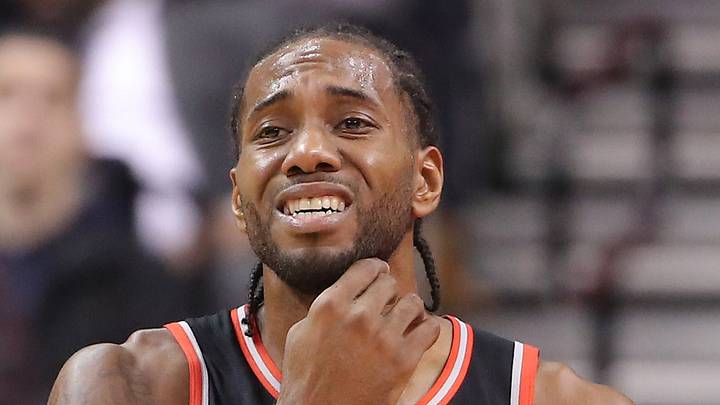
The Toronto Raptors sent shockwaves through the NBA on Tuesday, pulling off one of the most stunning reunions in league history by bringing Kawhi Leonard back to Scotiabank Arena. It is a move designed to ignite the city and cement the franchise’s championship ambitions. However, while the nostalgia is palpable and the excitement is off the charts, there is a looming, less glamorous reality: the Raptors have walked straight into a grueling financial minefield.
The Hard-Cap Dilemma
The mechanics of the deal have landed the front office in a precarious position. Because the trade involved sending out Brandon Ingram and Gradey Dick—whose combined salaries were lower than Leonard’s current figure—Toronto is now effectively “hard-capped” at the first apron. This significantly restricts the team’s ability to maneuver in the market, limiting the tools available to General Manager Bobby Webster as he tries to round out the rest of the roster.
With the trade processing date set for July 6th, the front office has a tiny window to mitigate this damage. They could look to expand the deal by including secondary players like Trayce Jackson-Davis or Jamison Battle, or perhaps explore a sign-and-trade for veterans like A.J. Lawson or Garrett Temple. Furthermore, the elephant in the room is Leonard’s own $7.45 million trade bonus. If he refuses to waive that amount, the deal could face significant hurdles or force the Raptors into an even more suffocating financial corner.
The Depth Crisis: Is the Core Strong Enough?
Looking back at the 2019 title-winning squad, the defining characteristic wasn’t just Kawhi’s brilliance—it was the incredible depth that shielded him during the regular season. This 2026 iteration, however, looks drastically different.
After processing the deal, the Raptors will likely find themselves with two roster spots to fill. Given their restrictive financial state, those spots must be filled with players on minimum contracts. This raises the most significant question of the offseason: Is an 8-man rotation enough to carry a core of Leonard and Scottie Barnes through an 82-game grind and a deep playoff run?
With injury history surrounding key contributors like Jakob Poeltl and Immanuel Quickley, the lack of frontcourt depth is genuinely alarming. If one of those foundational pieces misses significant time—as they did during the 2025-26 campaign—the roster could collapse, especially considering Leonard will almost certainly require a stringent “load management” plan.
The Case for an RJ Barrett Pivot
Given these constraints, the pressure on Bobby Webster to be creative is immense. Many analysts are now suggesting that the Raptors should at least explore trade avenues involving RJ Barrett. While trading a player of Barrett’s stature is a difficult pill to swallow, it may be the only way to transform a top-heavy, rigid rotation into a balanced, deep championship contender. Without addressing the lack of secondary shot creation and frontcourt stability, the team remains one injury away from disaster.
The Bottom Line
Bringing Kawhi Leonard home is a monumental victory for the organization, and his apparent commitment to retiring as a Raptor is a heartwarming narrative. But beneath the euphoria lies a cold, hard financial reality. The Raptors have cashed in their flexibility for a proven superstar, and in the current NBA salary cap landscape, that is a high-stakes gamble.
The front office has played the “chess” game to land their man, but now comes the real test: navigating the finances, managing Kawhi’s health, and rounding out the roster without the luxury of cap space. For Toronto, the championship window is wide open—but the path to the trophy has just become significantly narrower.
Do you believe the Raptors’ pursuit of Kawhi Leonard was worth the financial sacrifice, or has the front office left the roster too thin to compete? Should the Raptors trade RJ Barrett to add depth, or is he untouchable? Let us know your thoughts below!