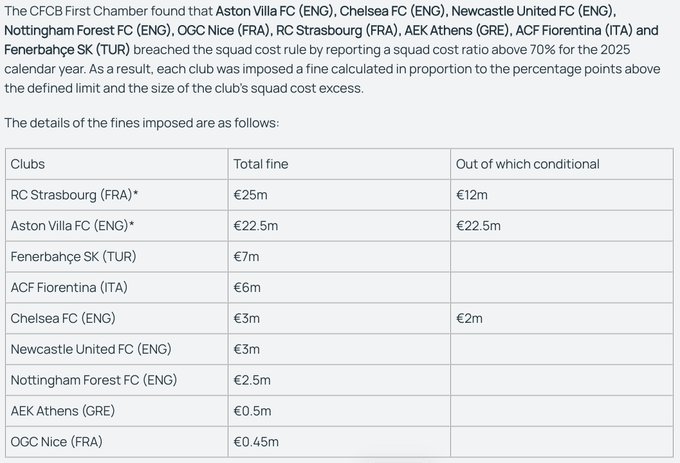
Aston Villa’s pursuit of European glory has hit a significant financial hurdle. The Europa League champions have been slapped with a massive €22.5 million (£19.3 million) fine by UEFA following a breach of the Squad Cost Ratio (SCR) regulations. However, as the dust settles on this controversial ruling, revelations have emerged regarding an initial administrative blunder by UEFA that has only added to the confusion surrounding the penalty.
A “Slightly Embarrassing” UEFA Blunder
Speaking exclusively to Football Insider, former Manchester City financial adviser Stefan Borson shed light on the chaos behind the scenes. According to Borson, UEFA’s initial communication regarding the fine was factually incorrect, an error he labeled as “slightly embarrassing” for the governing body.
While the original announcement suggested the entire penalty was conditional—meaning it could be waived if Villa complied with future regulations—the reality is far more immediate. Borson confirmed that a significant portion of the fine is, in fact, payable now. “Most of it is still conditional, but I think €7.5 million is payable,” Borson explained, setting the record straight on a situation that has left many Villa supporters confused about the club’s actual financial standing.
Why the Fine is So Staggering
The scale of the penalty has sent shockwaves through the fanbase. To reach a €22.5 million fine, it is clear that Aston Villa was “quite some way over” the allowed limits. For English clubs competing in Europe, the SCR allowance has tightened significantly, sliding down from an 85 percent threshold to 70 percent.
Villa, a club frequently criticized for its ballooning wage bill, appears to have struggled to adapt to these stringent parameters. When asked to estimate the extent of the overspend, Borson provided a sobering assessment: “To get to a €22.5m penalty in the second year, that probably means that their miss was something like €45 million, there or thereabouts.”
This discrepancy represents roughly 50 percent of the size of the club’s miss against their financial target. It is a figure that highlights the precarious nature of balancing high-level squad investment with UEFA’s rigid stability regulations. Borson was quick to clarify that this specific fine is distinct from other ongoing financial settlements, noting that the club must remain vigilant in its compliance over the next three years to avoid even harsher sanctions.
A Concerning Pattern for the Villans
The news has drawn sharp criticism from within the game. Keith Wyness, a former executive, has already publicly blasted the club’s financial management, calling recent punishments “totally embarrassing.” For the supporters, the concern is growing. While the Europa League trophy remains a highlight of the club’s recent history, the mounting fines—affecting not just Villa but fellow English clubs like Chelsea, Newcastle United, and Nottingham Forest—paint a worrying picture of the current financial landscape in the Premier League.
As Villa looks to build on their continental success, the pressure to streamline their operations has never been greater. With the club forced to navigate these complex regulatory waters, the message from financial experts is clear: the era of unchecked spending is officially over. Whether Aston Villa can find the right balance between their ambition for silverware and the constraints of the squad cost ratio will be the defining challenge for the board in the coming seasons.
Villa fans: Does this €22.5 million fine change your perspective on the club’s transfer strategy and wage structure? Is the success of winning the Europa League worth the ongoing battle with UEFA’s financial regulators, or is the club playing a dangerous game with its future? Let us know your take in the comments below!