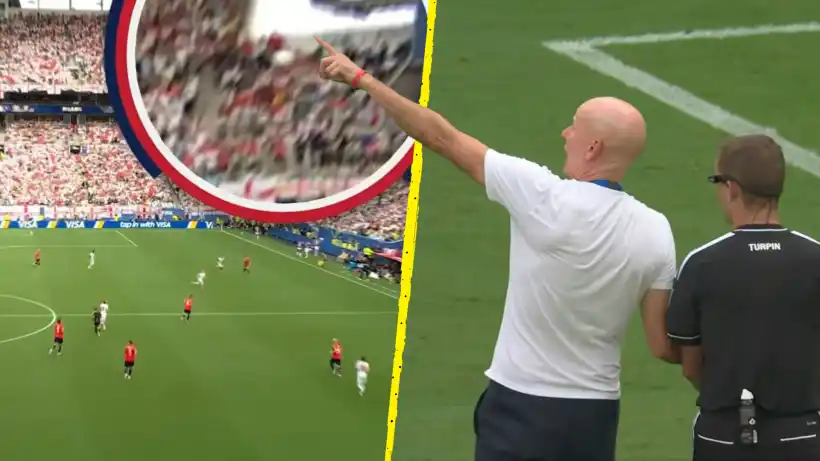
England’s dramatic path to the World Cup semi-finals has been anything but smooth, and their latest victory over Norway is now mired in a bizarre, high-tech officiating controversy. At the center of the storm is Jude Bellingham’s crucial first-half equalizer—a strike that, according to furious Norwegian officials, should have been wiped off the scoresheet due to an obscure rule involving the stadium’s aerial camera system.
The “Cable Contact” Incident
The drama unfolded just before the half-time whistle. A routine goal-kick from Norwegian goalkeeper Orjan Nyland seemed to behave in an unnatural, physics-defying manner as it soared toward midfield. To the naked eye, the ball appeared to make direct contact with one of the heavy-duty wires that suspend the stadium’s aerial camera above the pitch.
Under FIFA regulations, if the ball touches any equipment—including camera cables—the play should be immediately dead, resulting in a dropped ball. England regained possession in the chaos that followed and immediately countered, carving open the Norwegian defense to allow Bellingham to slot home his leveler.
Had the contact been confirmed, the goal would have been voided, and the momentum of the entire quarter-final tie would have shifted entirely in Norway’s favor.
The Tech vs. The Human Eye
Following the goal, the Norwegian camp was apoplectic. Manager Stale Solbakken, along with goalkeeper Orjan Nyland and superstar Erling Haaland, were seen gesturing frantically toward the overhead cables at the half-time break, clearly convinced they had witnessed a pivotal officiating blunder.
”Everyone saw what happened,” a livid Solbakken told reporters after the match. “The ball fell straight down… it was pretty clear that it hit it. It was a strange thing.”
However, FIFA’s response was swift and clinical. Officials cited data from the “connected ball” heartbeat sensor—a piece of cutting-edge technology embedded within the match ball—which monitors every micro-movement and impact. FIFA’s statement claimed that there was “no peak” on the heartbeat graph, asserting that the ball never actually struck the wire.
Former Premier League referee Mark Clattenburg, acting as an analyst for Fox, fueled the debate further by noting that VAR should have intervened regardless of the sensors: “An attacking phase of play leading to a goal is part of the VAR reviewable incident. It should have been picked up by the VAR.”
A Result Defined by Fine Margins
The goal stood, and it proved to be the lifeline England desperately needed after a dismal first-half performance. The Three Lions continued to labor after the break, with Norway coming within inches of finding a winner when they rattled the crossbar. As the match bled into extra time in the sweltering Miami heat, it was once again Bellingham who emerged as the hero, tapping in a rebound to secure a 2-1 victory and punch England’s ticket to the final four.
While England celebrates a historic win, the “Camera Cable Controversy” will undoubtedly leave a bitter taste in the mouths of the Norwegian contingent. In an era of high-definition replays and sophisticated microchips, it is ironic that the most contentious moment of the quarter-final remains a tug-of-war between high-tech sensors and the raw, frustrated observations of the players on the field.
England fans: Do you believe the technology got it right, or did Jude Bellingham’s goal receive an undeserved stroke of luck? Should FIFA provide clearer explanations for these “invisible” VAR calls? Let us know your thoughts in the comments below!