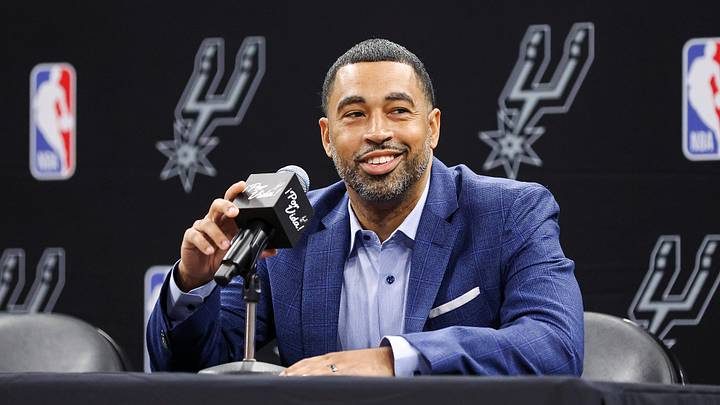
San Antonio Spurs general manager Brian Wright has quietly established himself as one of the sharpest executives in the NBA by methodically constructing a championship-caliber contender. While the rest of the league has engaged in frantic summer chaos—featuring seismic blockbusters like Giannis Antetokounmpo landing with the Miami Heat and LeBron James taking a league-minimum deal to join the Philadelphia 76ers—Wright has chosen a path of measured discipline.
Normally, missing out on back-to-back generational superstars would spark panic among a fan base. However, Wright’s calculated restraint is turning out to be a stroke of absolute genius. Rather than derailing a proven trajectory, the Spurs front office is steadfastly refusing to cheat the organic development process.
Resisting the Sirens: Why Trading for Steph Curry is a Trap
That disciplined approach extends directly to blockbuster rumors surrounding Golden State Warriors icon Stephen Curry. Following external suggestions—including high-profile pitches from media analysts like The Ringer’s Bill Simmons—arguing that San Antonio should cash in their chips for Curry, Wright has rightly stayed completely away.
While acquiring a legendary shooter like Curry would undeniably cause a temporary media frenzy, the staggering cost makes it a catastrophic long-term trap. To pry Curry away from Golden State, San Antonio would be forced to completely gut their foundation. A hypothetical package would likely start with De’Aaron Fox, prized rookie Carter Bryant, and up to four unprotected first-round picks.
Even if the Spurs somehow managed to retain a couple of draft assets, they would still have to sacrifice elite young foundational pieces like Stephon Castle or Dylan Harper. Sacrificing the club’s entire future for two or three twilight seasons of Curry when San Antonio was already knocking on the door of a championship—falling just a few wins shy in the NBA Finals against the New York Knicks—simply does not make mathematical or competitive sense.
Taking a Page From the 2014 Championship Playbook
Instead of orchestrating seismic, high-risk roster overhauls, Wright is drawing inspiration directly from San Antonio’s historic past. In many ways, the current roster mirrors the legendary 2014 championship-winning Spurs. Rather than blowing up a team that was already contending at the highest level, that iconic front office simply executed smart, surgical tweaks to the supporting cast.
Wright has mirrored that exact blueprint this summer. By focusing on smart, low-key roster adjustments rather than splashy headlines, he has systematically fortified the team’s depth.
The strategic addition of veteran forward Tobias Harris injects vital leadership and stability into the power forward rotation. Meanwhile, bolstering the frontcourt depth behind superstar Victor Wembanyama and Luke Kornet by bringing in exciting young talents like Tarris Reed Jr. and Jayden Quaintance—while cleanly parting ways with three aging veteran centers—makes the team younger, more athletic, and infinitely more resilient.
Why the Spurs Are Already Built to Win
When looking at the internal growth matrix, San Antonio doesn’t need a panic trade. Natural, expected offseason progression from budding stars like Victor Wembanyama, Stephon Castle, and Dylan Harper alone creates an internal ceiling that most franchises can only dream of. Factor in a regression to the mean and bounce-back performances from De’Aaron Fox alongside an upgraded, cohesive bench unit, and the Spurs could easily surpass the stellar squad that dominated last season.
If everything clicks according to plan, next year’s silver-and-black juggernaut will be even more terrifying than the team that captured 62 wins and reached the NBA Finals. When that happens, Brian Wright will once again be vindicated for resisting the temptation of flashy summer headlines in favor of sustainable, long-term brilliance.