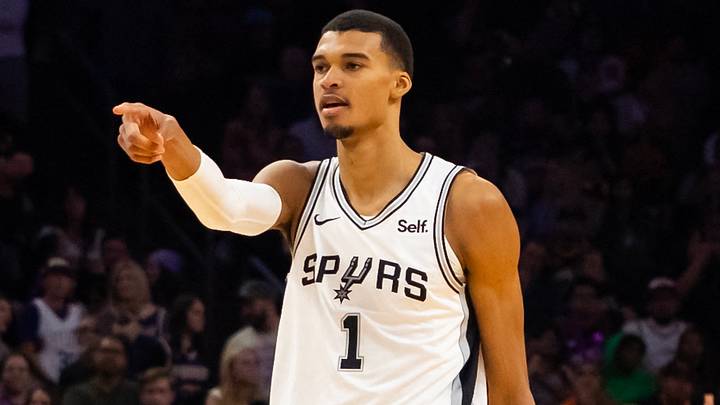
Throughout the rich, storied history of the National Basketball Association, comprising roughly 5,000 players who have ever stepped foot on a hardwood floor, only a select few truly possessed the power to fundamentally alter how the game is played. Whether through the implementation of sweeping rule changes or the genesis of league-wide tactical trends, transcendent superstars leave an indelible footprint that echoes long after they hang up their sneakers.
San Antonio Spurs megastar Victor Wembanyama is hurtling toward that exact stratosphere. While much of the discourse surrounding the French phenom focuses on his unprecedented blend of guard-like skill and 7-foot-4 dimensions, a quieter, more tactical revolution is brewing right under our noses—one that could completely redefine rim protection across basketball.
Turning Rejection into Possession: The Art of Controlled Swats
For decades, defensive highlights have been defined by thunderous, crowd-pleasing blocks that send basketballs soaring into the fifth row or deep into the scorer’s table. Yet, from a cold, analytical perspective, spiked blocks are often inefficient. Unless the rejecting defender or a teammate can ensure the ball stays in bounds, the defensive team is simply forcing a reset. The opponent retains possession, gets a fresh shot clock, and has another opportunity to score, rendering the defensive effort largely moot.
Victor Wembanyama has quietly flipped this entire defensive philosophy on its head.
Wemby has mastered the art of blocked-shot control. Rather than relying solely on brute force to obliterate opposing layup attempts, the Defensive Player of the Year routinely utilizes his preternatural timing and astronomical wingspan to corral or gently redirect shots directly into his own hands or toward an open teammate.
This subtle yet profound adjustment transforms a routine defensive stop into an immediate offensive weapon. By turning blocks into live-ball turnovers, Wembanyama single-handedly sparks instantaneous fast breaks, shifting the psychological burden onto bewildered opponents who suddenly find themselves scrambling backward in transition defense.
The Numbers Game: Why Possessions Are the Ultimate Currency
In the high-stakes chess match of modern basketball, possessions are treated as currency. The fundamental objective of the sport remains painfully simple: score more points than the opposition. To maximize scoring output, a team must generate as many high-percentage shot attempts as possible while limiting the opponent’s opportunities.
By converting blocks into possessions, Wembanyama effectively creates a statistical surplus for the Spurs. Every controlled rejection prevents a second-chance opportunity for the offense while simultaneously gifting San Antonio an advantageous transition scenario. It forces opposing coaches to completely re-evaluate their floor balance and offensive spacing, knowing that any blocked shot in the paint could instantly materialize as a runaway dunk on the other end.
The Inevitable League-Wide Snowball Effect
While critics might argue that Wembanyama’s physical canvas is entirely unreplicable—after all, cloning a player with a staggering wingspan and fluid mobility is impossible—the strategy behind his shot-blocking is entirely teachable.
Basketball is a copycat league. As smart coaches review game film and witness how severely Wembanyama’s controlled rejections tilt the momentum of games, the pressure will mount on defensive coordinators across the association to adapt. It won’t be long before rim protectors at every level of basketball are instructed to stop swatting balls out of bounds and start prioritizing possession control.
If the rest of the NBA wises up and adopts Wembanyama’s blueprint, we are on the precipice of a full-scale defensive revolution. The transition game will become faster, more lethal, and more heavily emphasized than ever before. And when historians look back at the catalyst for this evolution, the trail will lead straight back to San Antonio and the unprecedented genius of Victor Wembanyama.