Leeds United’s Carabao Cup campaign ended in spectacular fashion at Stamford Bridge, but the 6-3 defeat to Chelsea has continued to generate controversy well beyond the final whistle.
Daniel Farke’s side appeared to be cruising towards one of the biggest shocks of the third round after producing an excellent opening period against Chelsea. Leeds established a two-goal advantage and looked capable of completing a memorable result in west London.
Instead, the game completely unravelled after a contentious penalty decision sparked a remarkable Chelsea comeback.
Leeds took control when Tarik Muharemovic found the net with a header, giving Farke’s team a deserved lead. Brenden Aaronson then increased the advantage shortly after the interval, putting the visitors in an excellent position.
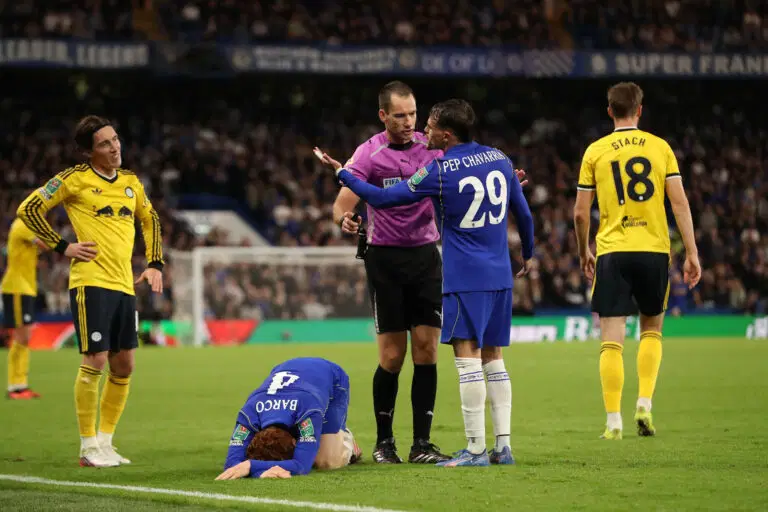
But everything changed when referee Jarred Gillett awarded Chelsea a penalty following a challenge involving Dan James and Pep Chavarria.
The decision immediately became a major talking point, with the Leeds camp believing the contact did not warrant a spot-kick. Cole Palmer made no mistake from 12 yards, and Chelsea suddenly found the momentum they had been missing.
What followed was a devastating spell for Leeds.
Chelsea scored four times in just 12 minutes, transforming a 2-0 deficit into a 4-2 advantage. The speed of the turnaround left Leeds struggling to regain control of a match they had dominated for long periods.
Farke’s team refused to surrender completely, however.
Substitute Noah Okafor combined with Dominic Calvert-Lewin to produce Leeds’ third goal and reduce the deficit to 4-3. Suddenly, the visitors had a route back into the contest.
Then came another decision that has left Leeds supporters questioning the officiating.
Okafor was brought down close to the Chelsea penalty area, but Gillett chose not to award a foul. With VAR unavailable during this stage of the Carabao Cup, the decision could not be reviewed and play continued.
According to journalist Adam Pope, Farke subsequently revealed that the referee apologised after the game for failing to spot the incident involving Okafor.
That reported admission has added another layer to an already frustrating night for Leeds.
The controversy is particularly significant because the earlier Chelsea penalty played such an important role in changing the momentum of the contest. Leeds had looked comfortable before Palmer’s spot-kick gave Chelsea the opening they needed.
However, Farke cannot simply blame the officials for the defeat.
The Leeds manager will also know that his team contributed to its own downfall. After Chelsea gained momentum, Leeds struggled defensively and failed to respond quickly enough to the dramatic change in the match.
The four-goal collapse in such a short period exposed vulnerabilities that Farke will undoubtedly want to address.
The final scoreline ultimately read Chelsea 6-3 Leeds United, with Muharemovic, Aaronson and Calvert-Lewin getting on the scoresheet for the visitors.
For Leeds, though, the result was about more than simply being eliminated from the competition.
They will undoubtedly be frustrated by how a match they controlled for long stretches slipped away so quickly. The reported post-match acknowledgement from the referee regarding the Okafor incident only adds to the feeling that key decisions went against Farke’s side.
At the same time, Leeds must learn from the collapse.
Chelsea’s comeback demonstrated how quickly Premier League-quality opposition can punish defensive uncertainty, particularly once momentum shifts.
Farke will therefore have plenty to analyse from the defeat. The officiating will remain part of the discussion, but so too will Leeds’ inability to protect a two-goal advantage and respond effectively during Chelsea’s extraordinary 12-minute surge.
What began as a potentially famous Leeds victory ultimately became a painful Carabao Cup exit — and the reported referee apology has ensured the controversy surrounding the night will not disappear anytime soon.