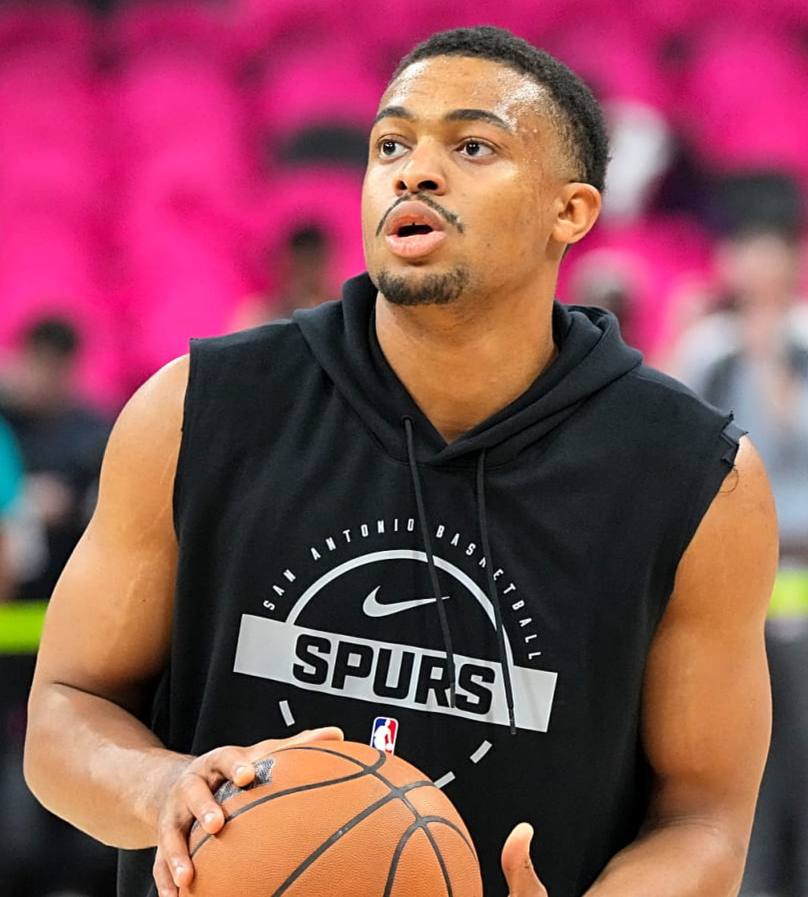
The San Antonio Spurs have spent the offseason putting together a roster that looks increasingly capable of challenging for the NBA championship. But while the arrival of veteran forward Tobias Harris has added another layer of experience and versatility to the team, it may have also created a difficult decision that the front office can no longer ignore.
Suddenly, one of the franchise’s longest-serving players could find himself at the centre of a major trade conversation.
Keldon Johnson has been an important figure throughout San Antonio’s rebuilding process. He has developed into a respected presence inside the locker room and has often been described as one of the emotional leaders of the team.
However, the Spurs are no longer simply building for the future.
With Victor Wembanyama leading an ambitious roster and the organization increasingly viewed as a serious contender, every position and rotation decision carries greater significance. Harris’ arrival could therefore have unintentionally changed Johnson’s situation in San Antonio.
Harris changes the equation
The addition of Harris gives the Spurs another experienced player capable of contributing on both ends of the floor. More importantly, it gives San Antonio additional flexibility in the forward rotation.
That could make Johnson’s position increasingly vulnerable.
Johnson is entering the final year of his contract, with approximately $18 million remaining on his salary. From a trade perspective, that could make him relatively straightforward for interested teams to accommodate financially.
But the bigger issue is basketball-related.
The Spurs now have several players competing for minutes around Wembanyama, and Johnson’s role is no longer as secure as it once appeared.
Julian Champagnie has already moved ahead of him in the rotation, while young prospect Carter Bryant could push for a larger role. Veteran Harrison Barnes also provides San Antonio with another dependable option capable of filling minutes when required.
That leaves Johnson facing a particularly important season.
His playoff struggles could matter
Johnson’s regular-season contribution cannot simply be dismissed.
He won the Sixth Man of the Year award and has played a significant role in San Antonio’s rise. Yet his postseason performance raised legitimate questions about whether he can remain a major piece of a championship-calibre rotation.
During the playoffs, Johnson averaged only 7.7 points and 3.3 rebounds per game while shooting 40.7 percent from the field.
There were flashes of the player San Antonio knows he can be, but consistency became a major issue.
His decision-making also proved problematic at times, leaving the coaching staff with fewer reasons to trust him in high-pressure situations.
For a rebuilding team, those concerns might be easier to overlook.
For a team expecting to compete deep into the postseason, they become much harder to ignore.
San Antonio faces a difficult call
Trading Johnson would undoubtedly be an emotional decision.
He is not just another player on the roster. He has been around throughout much of the Spurs’ transition from rebuilding project to emerging contender and has developed a strong connection with the organization.
That makes the possibility of moving him particularly uncomfortable.
Yet NBA teams competing for championships routinely have to make cold-blooded decisions.
San Antonio cannot allow sentiment to determine its roster if the ultimate objective is to build the strongest possible team around Wembanyama.
Harris’ arrival may have provided exactly the depth and experience required to make such a decision easier.
If Johnson responds with a major bounce-back season, the entire conversation could disappear. A return to his best form would give the Spurs another dangerous offensive weapon and could force his critics to reconsider his long-term value.
But if his struggles continue and his role diminishes further, the trade deadline could become extremely interesting.
Johnson’s next few months could decide everything
The Spurs do not necessarily have to move Johnson immediately.
In fact, keeping him through the beginning of the season could give San Antonio an opportunity to evaluate how the new-look rotation functions in real games.
His expiring contract could also become increasingly valuable as the deadline approaches.
If Johnson performs well, San Antonio could keep him as an important part of its championship push. If he struggles or becomes buried on the depth chart, however, the Spurs could explore the market and potentially turn his contract into another useful piece.
That is what makes the situation so fascinating.
The arrival of Harris was supposed to strengthen San Antonio.
Instead, it may have created a major roster crossroads.
Johnson remains a respected figure inside the organization, but championship ambitions can force even popular players into uncomfortable situations.
For now, his future in San Antonio may depend less on his reputation and much more on what he does once the season begins.
If he rediscovers his best form, the Spurs may have no reason to consider a move.
If he doesn’t, San Antonio could eventually face one of the toughest decisions of its new era: choosing between loyalty to one of its longest-tenured players and making the ruthless move necessary to maximize Wembanyama’s championship window.