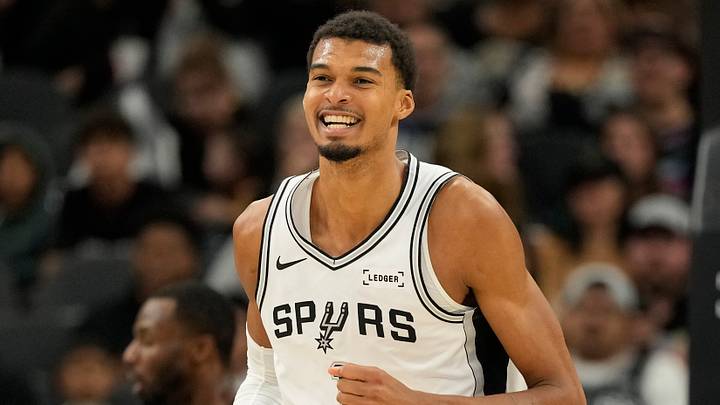
As the dust settles on an electrifying NBA Finals matchup, hot takes from around the league continue to make waves. Recently, an anonymous NBA scout suggested to Sports Illustrated that the New York Knicks somehow cracked the code on how to slow down San Antonio Spurs superstar Victor Wembanyama.
According to the scout, the Knicks “laid the blueprint” by repeatedly dragging Wembanyama into early-possession ball screens to wear him out. While it makes for an intriguing storyline, this narrative completely misrepresents what actually happened on the floor. New York certainly deserves full credit for capturing a championship and capitalizing on the youth and fatigue of their opponents, but claiming they discovered a magical strategic formula is a massive stretch.
The Absurdity of the “Tire Out The Alien” Strategy
Before dissecting the logistics, it is worth pausing to appreciate how humorous it is to hear a professional basketball scout argue that your best chance at defeating a generational 7’4″ talent is simply to hope he gets tired. If a coaching staff enters a series relying on exhaustion as their primary defensive equalizer, they are already operating from a defeatist mindset.
The reality of why Wembanyama appeared gassed on the game’s biggest stage comes down to a grueling physical buildup and self-inflicted roster mileage, rather than some defensive masterclass cooked up in Manhattan.
A Heavy Cumulative Workload and Injury History
To understand why Wembanyama looked fatigued in the Finals, you have to look at the entire context of his season. Vic played only 46 games the previous year before being sidelined by a blood clot diagnosis. When the 2025–26 campaign tipped off, he was initially thrust into a heavy workload, averaging 34.3 minutes per contest.
That heavy early pace was temporarily halted when he suffered a calf strain just 12 games in. Upon his return, the Spurs’ medical and coaching staff carefully monitored his minutes, causing him to finish the regular season averaging a much more moderate 29.2 minutes per game.
A Brutal Playoff Gauntlet Took Its Toll
While San Antonio breezed through the opening rounds—sweeping past the Trail Blazers and Timberwolves by an average margin of 21.1 points, which allowed Wembanyama to log lighter minutes (28.1 MPG against Portland and 29.2 MPG against Minnesota)—things escalated dramatically in the Western Conference.
A grueling seven-game Western Conference Finals series against the defending champions required massive minutes in a hostile environment, with Wembanyama averaging 37.7 minutes per game. That fatigue carried straight into the NBA Finals against New York, where he was forced to shoulder an enormous load, routinely playing full 12-minute quarters and averaging a staggering 39.8 minutes over the series. By that point, his body simply hit a wall.
Wembanyama was worn down by an exhausting postseason run that his body was ultimately ill-prepared to handle after an interrupted year. It had very little to do with anything groundbreaking the Knicks did, and it certainly does not constitute a reproducible “blueprint” for the rest of the league.