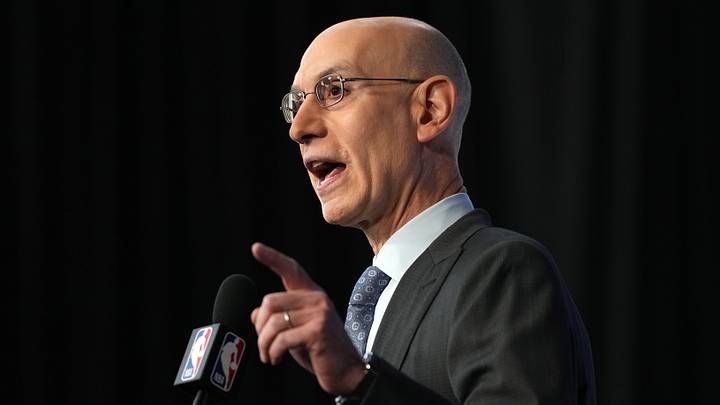
NBA Commissioner Adam Silver has made no secret of his admiration for the league’s stringent new financial architecture. Speaking candidly in recent months, Silver defended the second apron, openly admitting that it was intentionally designed to be “more NFL-like” to foster parity—pointing to the fact that the league has crowned eight different champions over the last eight years.
For fans of traditional big-spending franchises, Silver’s defense of the system sounds like an immovable roadblock. However, for supporters of the San Antonio Spurs, there is no need to panic. While the commissioner’s comments signal a firm opening negotiating stance, the second apron rules as they stand today are far from permanent, and they won’t dictate the ultimate ceiling of San Antonio’s burgeoning young core.
The Collective Bargaining Reality Check
The crucial factor often overlooked in these debates is that Adam Silver does not write the NBA rulebook in a vacuum. A Collective Bargaining Agreement (CBA) is, by definition, a bilateral pact requiring two signatures—and the National Basketball Players Association (NBPA) holds the other pen.
Silver’s desire to preserve the status quo sets up a high-stakes showdown, but history suggests the players’ union will not simply roll over. The current CBA includes glaring oddities and unintended consequences—such as high-profile max-contract anomalies and drastic pay cuts for veteran icons like LeBron James—that provide the union with plenty of ammunition when negotiations resume.
As Silver himself recently conceded, running a league is a continuous exercise in compromise: “There’s always things that they want. There’s always things that we want. I think in any partnership, there’s trades made along the way.”
We have seen this movie before. Back in 2011, owners pushed aggressively for a hard salary cap, only to back down after a grueling 161-day lockout. While compromises are always struck and lockouts carry real financial risks, a united player’s union inevitably forces the league to blink and grant concessions when financial pressure mounts.
The Perfect Timeline for San Antonio’s Core
For the Spurs, the macroeconomic battle over the CBA aligns almost too perfectly with their internal payroll calendar.
- Victor Wembanyama: The generational superstar’s five-year, $252 million extension kicks off in the 2027-28 season.
- Stephon Castle: Becomes extension-eligible as early as next summer.
- Dylan Harper: Set for extension eligibility in the summer of 2028, with his lucrative pay raise landing ahead of the 2029-30 campaign.
Meanwhile, the union’s calendar grants either side the right to opt out of the current CBA following the 2028-29 season. This means that if the players push back against crippling apron restrictions and force the league to soften the rules, a newly rewritten CBA could take effect precisely when Dylan Harper’s extension hits the books.
This synchronization provides a golden window of opportunity. It gives the Spurs a realistic pathway to keep Wembanyama, Castle, and Harper surrounded by high-level talent without being choked by inflexible apron penalties.
The Road Ahead
Naturally, labor disputes carry risks, and a potential work stoppage around 2029 could test everyone’s patience. But Spurs fans envision a future where this young, electrifying core grows up together to compete for championships for years to come.
Seeing that carefully constructed unit dismantled prematurely simply due to rigid financial formulas would be a bitter pill to swallow. Fortunately, Adam Silver’s opening salvo is just that—an opening salvo. When the dust settles and the players hold the line, the financial rules of the NBA will likely look very different by the time San Antonio’s championship window swings wide open.