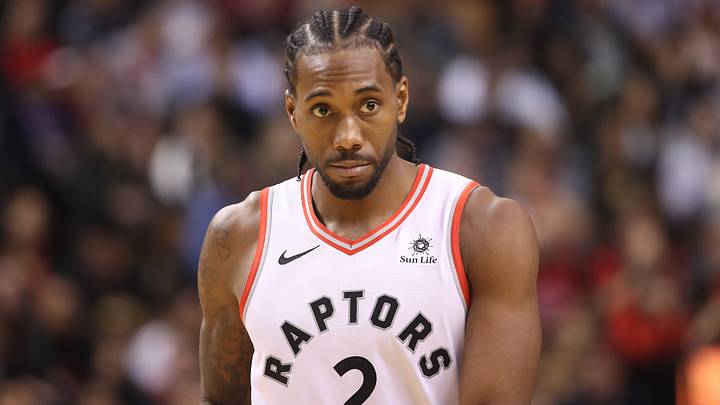
The blockbuster reunion between Kawhi Leonard and the Toronto Raptors has officially entered its next phase following the forward’s two-year, $115 million contract extension. For a franchise starved of elite superstar gravity, locking down a player of Leonard’s caliber provides an immediate boost and establishes a clear three-year championship window alongside cornerstone Scottie Barnes.
Unlike his first arrival in Toronto—where his long-term commitment remained an open question—Leonard has signaled a genuine desire to anchor the franchise moving forward. However, paying top dollar for a 35-year-old superstar with a well-documented injury history has sparked intense debate across the league regarding whether Toronto may have overpaid.
Comparing Stars: Kawhi vs. Kevin Durant
The financial optics of Leonard’s extension look particularly heavy when stacked against similar veteran max deals across the association. On a recent appearance on the Third Apron Podcast, CBS Sports cap analyst Sam Quinn highlighted the stark contrast between Leonard’s contract and Kevin Durant’s two-year, $90 million extension with the Houston Rockets.
According to Quinn, Leonard’s deal commands nearly 32% of the salary cap in each of its active years, whereas Durant’s contract sits comfortably around 26.5%.
”Kawhi’s contract is going to pay him just under 32% of the cap in each of his two years,” Quinn explained. “Kevin Durant’s deal is going to pay him, I think, 26.5% or so in both years of his extension… This feels a little heavy to me.”
While Quinn acknowledged that Leonard was arguably the slightly better player last season and remains slightly younger, Durant represents a somewhat more reliable health profile. More importantly, Durant’s contract structure includes built-in safeguards accounting for potential age-related regression as players approach their late thirties. By contrast, Toronto committed max-level money assuming absolute health and peak output across the board.
Trusting the Medical and Developmental Staff
The Raptors’ front office is betting heavily on their proven ability to manage player workloads. Toronto’s medical and coaching staff famously engineered a flawless load-management and health program during Leonard’s historic 2018-19 championship run, guiding him through 60 regular-season games and a grueling postseason. Furthermore, the front office successfully managed Brandon Ingram’s health through a heavy workload last year, reinforcing their confidence in handling elite talent.
When healthy, Leonard proved last season that he remains a top-ten player in the NBA. Over a 65-game sample, he posted elite numbers:
- Points Per Game: 27.9
- Rebounds Per Game: 6.4
- Assists Per Game: 3.6
- Steals Per Game: 1.9
- Shooting Splits: 50.5% FG / 38.7% 3PT
When he is on the floor, his two-way dominance is undeniable. If he replicates that production and pushes Toronto back into deep playoff contention, the financial investment will be entirely justified.
The Margin for Error
However, the margin for error in Toronto is razor-thin.
If injuries derail Leonard’s availability—compounding existing concerns surrounding other pricey commitments on the books, such as Jakob Poeltl and Immanuel Quickley—this extension will face heavy scrutiny. The front office has built a fierce, competitive roster ready to make noise in a brutal Eastern Conference, but the ultimate success of this era rests squarely on the fragile shoulders of Kawhi Leonard.
For better or worse, the Raptors have placed their chips right in the middle of the table.