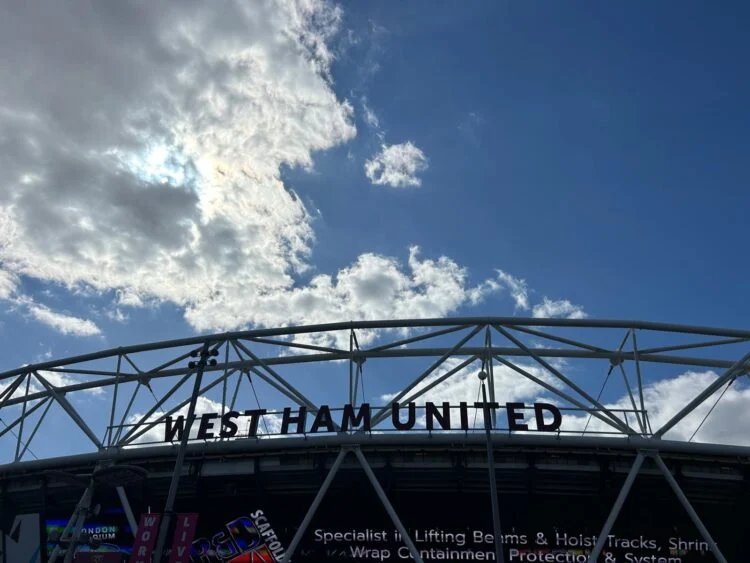
For years, the debate surrounding West Ham United and the London Stadium has remained one of the most polarizing topics in English football. Ever since the club’s emotionally charged departure from Upton Park in 2016 to relocate to the former 2012 Olympic venue, supporters have dreamed of a day when the team could truly call their home their own—and redevelop it into a cauldron tailored specifically for football.
That dream recently flickered back to life when London Mayor Sadiq Khan publicly opened the door to a potential sale of the Stratford arena. However, a major exclusive update from inside the club has revealed a sobering reality: hopes of the current ownership purchasing and transforming the ground may have effectively died alongside Amanda Staveley’s failed takeover bid.
The Staveley Dream and the Mayor’s Invitation
One of the primary reasons West Ham supporters rallied so enthusiastically behind Amanda Staveley’s proposed takeover consortium was the promise of a sweeping “property play.” Staveley’s group was widely believed to be laying the groundwork for a blockbuster attempt to buy the London Stadium outright, aiming to fundamentally alter the relationship between the club and its home.
However, that takeover momentum ground to a halt when billionaire Daniel Kretinsky and co-chairman David Sullivan exercised their pre-emption rights. Kretinsky increased his holding to 46 percent, while Sullivan’s stake rose to 40 percent, keeping control firmly in familiar hands for now.
Shortly after, London Mayor Sadiq Khan offered a potential lifeline to supporters. Responding to a query from London Assembly member Bassam Mahfouz, Khan stated that City Hall would “consider any credible proposal” from the Hammers, provided that any transaction protected the public interest, delivered value for taxpayers, and preserved the stadium’s wider economic and sporting benefits.
To many, it looked like a golden, once-in-a-generation invitation. But behind the scenes at West Ham, the leadership views the proposition through an entirely different lens.
Why West Ham’s Ownership Rejected the Stadium Offer
When Hammers News approached a top-ranking executive source inside the club to ask whether the new-look ownership structure would pursue Khan’s offer and buy the stadium to satisfy supporters’ wishes, the response was blunt and revealing.
“It’s worth zero as you take on a £20m per year loss, and quite soon there is possibly some very heavy capital expenditure on the ground itself,” the high-level source exclusively revealed.
“It only works if they throw in some more land or property, but the real problem is the contract with UK Athletics. It’s a very complicated issue.”
The core of the financial hesitation stems from the staggering operational reality of the venue. The stadium currently runs at a continuing annual deficit estimated around £20 million—a heavy financial burden that West Ham currently avoids by maintaining their long-term 99-year lease (with roughly 89 years remaining) rather than bearing full ownership.
Furthermore, acquiring the ground would mean inheriting massive, looming capital expenditure costs alongside the fiercely complicated legal and operational restrictions tied to UK Athletics’ long-term agreement to use the facility. Without additional land parcels included to make a commercial property venture viable, the numbers simply do not add up for the board.
A Bitter Pill for the Claret and Blue Faithful
For fans who have spent a decade yearning for steeper stands, closer proximity to the pitch, and an atmosphere that matches the historic intensity of Upton Park, this latest development is a tough pill to swallow.
Sadiq Khan has publicly signaled that the door to a sale is unlocked, and local lawmakers have actively championed the idea of putting the stadium into the hands of the club. Yet, the economic realities laid bare by the club’s leadership mean that supporters may have to wait indefinitely for their stadium dreams to materialize.
For the foreseeable future, the London Stadium will remain what it has been since 2016: West Ham United’s home, but crucially, not West Ham United’s property.
Do you think West Ham’s ownership made the right financial decision in passing on Sadiq Khan’s offer, or should the club buy the stadium to give fans the football-specific home they desire?