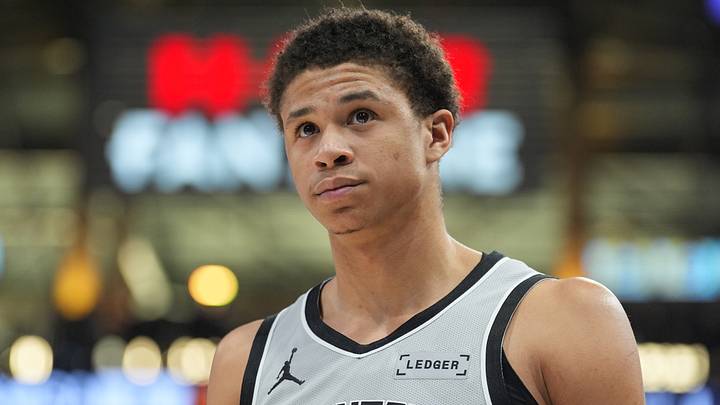
As the San Antonio Spurs fine-tune their strategy for the upcoming NBA campaign, head coach Mitch Johnson faces a classic luxury-turned-headache: how to maximize the playing time and development of an exceptionally talented young core. Among the hottest topics of debate in Spurs Nation is the possibility of thrusting sophomore guard Dylan Harper into the starting lineup alongside De’Aaron Fox and Stephon Castle.
While putting all three playmakers on the floor together sounds like an offensive dream on paper, closer inspection reveals a troubling downstream effect. Specifically, this guard-heavy configuration threatens to create a severe roster logjam that could inadvertently stunt the growth of promising young forward Carter Bryant.
Breaking Down the Rotation Math
To understand why a three-guard starting unit causes a major ripple effect, you have to look at the math behind an NBA game. With 48 minutes available across five distinct positions, a team has a strict total of 240 minutes to distribute.
If Fox, Harper, and Castle each earn starter-level minutes averaging around 30 per night, that accounts for 90 minutes right off the bat. Factor in the center position—where Victor Wembanyama, Luke Kornet, and Tarris Reed Jr. combine to soak up 48 minutes—and add roughly 27 minutes for floor-spacer Julian Champagnie, and you have already accounted for 165 of the 240 available minutes.
This leaves a meager 75 minutes remaining to split among a crowded wing and forward group featuring Devin Vassell, Tobias Harris, Keldon Johnson, Harrison Barnes, and Carter Bryant. Even if established veterans like Vassell and Harris command the lion’s share of those leftover minutes, the remaining margin for younger players shrinks to near zero.
Although Castle and Harper boast impressive positional size at 6’6″ and 6’5″, deploying them as nominal wings within a three-guard framework ultimately starves the natural forward rotation of essential floor time.
Carter Bryant’s Development Hangs in the Balance
For a franchise with one eye firmly on sustained, long-term contention, prioritizing the progression of players like Carter Bryant should remain paramount.
During his rookie campaign, the former Arizona standout offered tantalizing glimpses of his immense two-way upside. Despite playing limited minutes—averaging 11.5 during the regular season and 8.5 in the postseason—Bryant showcased a lethal combination of hellacious perimeter defense and highly efficient shooting, highlighted by a stellar 41% clip from beyond the arc.
For Bryant to unlock his full potential and evolve into an impact starter, he requires consistent developmental minutes. However, if San Antonio decides to prioritize starting Harper alongside Fox and Castle, Bryant risks being squeezed out of the rotation entirely, with veterans like Keldon Johnson and Tobias Harris also demanding court time.
Striking the Right Balance for San Antonio’s Future
The challenge for Mitch Johnson is clear: how to balance the immediate desire to showcase Dylan Harper’s superstar trajectory without sacrificing the foundational growth of depth pieces like Bryant.
While experimenting with multi-guard lineups will undoubtedly happen in spurts, locking into a permanent three-guard starting unit risks creating a bottleneck that ripples through the entire bench. For the Spurs to win both today and tomorrow, managing the minutes crunch will be the ultimate test of coaching ingenuity.
Do you think the Spurs should start Dylan Harper to accelerate his development, or would bringing him off the bench be a safer way to preserve minutes for Carter Bryant and the rest of the wing rotation?