The Toronto Raptors could be preparing for a major shake-up, with Anthony Davis once again emerging as a potential trade target. Bringing the superstar big man to Toronto would undoubtedly transform the team’s ambitions, but there is one major consequence that the front office cannot afford to overlook.
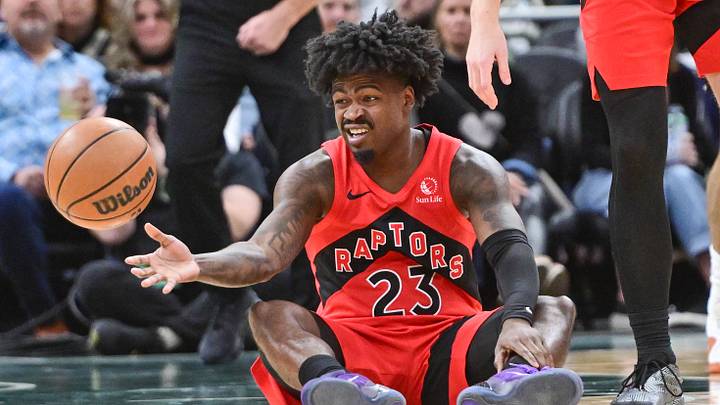
A deal for Davis could leave Jamal Shead facing the biggest challenge of his young NBA career.
Toronto has an opportunity to build a formidable roster around Davis, Scottie Barnes and Kawhi Leonard, provided all three can stay healthy. However, acquiring another superstar would almost certainly require significant sacrifices, and one proposed trade scenario involves sending Immanuel Quickley and RJ Barrett to the Washington Wizards.
That would be an enormous move for the Raptors. Davis has been producing at an elite level this season, averaging 25.6 points, 10.1 rebounds, 2.0 assists and 2.3 combined steals and blocks per game. He has also converted 35 per cent of his attempts from beyond the arc and has missed only two of Washington’s first 19 games.
His arrival would immediately strengthen Toronto’s frontcourt and give the franchise another player capable of taking over games.
But while the potential benefits are obvious, the departure of Quickley would leave a significant vacancy in the starting backcourt.
That is where Shead enters the picture.
Anthony Davis could change everything for Toronto – but Shead would inherit a massive responsibility
If Toronto traded Quickley and Barrett for Davis, Shead would become a leading candidate to move into the starting lineup alongside Ja’Kobe Walter.
It would represent a considerable change in responsibilities.
Shead has primarily operated as an important contributor to the Raptors’ second unit, where his playmaking and ability to organise the offence have helped the team maintain its rhythm when the starters are off the floor.
However, becoming the starting point guard is an entirely different challenge.
Instead of directing the bench unit, he would be expected to organise an offence featuring Davis, Barnes and Leonard. He would have to create opportunities for three high-level players while also ensuring that opposing defences could not simply ignore his own scoring threat.
That is a lot to demand from a young guard who is still developing his offensive game.
Shead’s shooting could become Toronto’s biggest concern
There is no question that Shead possesses impressive playmaking qualities.
This season, he has averaged 6.3 assists per game while shooting 38.5 per cent from the field and 30.5 per cent from three-point range.
Those shooting numbers are not particularly encouraging for a player who could soon become the primary ball-handler in a starting lineup.
His situation deserves some context, though.
At 6-foot-1, Shead does not enjoy the physical advantages that many NBA guards possess. Longer defenders can make it difficult for him to create comfortable shooting opportunities, particularly when he is responsible for generating offence for the second unit.
His role also requires him to prioritise creating chances for teammates rather than constantly looking for his own shot.
That helps explain why his overall production should not be judged purely through his shooting percentages.
Nevertheless, the concerns would become much more significant if Toronto promoted him into a starting role.
As the team’s lead guard, he would face greater defensive attention and would be expected to provide more consistent scoring.
The Raptors cannot simply assume that his shooting will improve because he is playing alongside better teammates.
Davis could make Shead a better playmaker
There is, however, a very attractive side to this potential partnership.
Davis is an excellent offensive option for a point guard who understands how to distribute the basketball.
Shead’s passing ability could become particularly valuable in pick-and-roll situations, where Davis would offer a dangerous combination of size, mobility and finishing ability.
Toronto has already seen Shead develop an encouraging connection with Jakob Poeltl when the two have shared the floor.
Davis would provide an even more imposing target.
The presence of Barnes and Leonard would also give Shead additional options. Rather than being expected to manufacture every scoring opportunity himself, he could focus on getting the ball to Toronto’s most dangerous offensive players in advantageous positions.
In that sense, a Davis trade could actually make Shead’s playmaking responsibilities easier.
The problem is that playmaking alone may not be enough.
Modern NBA defences are increasingly willing to exploit guards who cannot consistently punish opponents for leaving them open. If defenders do not respect Shead’s outside shooting, they can crowd the driving lanes, help against Davis and make life considerably more difficult for Toronto’s other stars.
That is the danger the Raptors would need to consider.
Bobby Webster could be placing too much faith in an unproven backcourt
For general manager Bobby Webster, acquiring Davis would be a major statement of intent.
A healthy Davis, Barnes and Leonard would give Toronto an impressive collection of star-level talent and potentially transform the team’s position in the Eastern Conference.
But such a move would also involve significant risk.
Trading Quickley and Barrett would remove two established offensive contributors. Walter could be asked to take on a larger role, while Shead would suddenly become responsible for running the starting offence.
Walter’s offensive consistency is another factor worth considering. Although his potential as a three-and-D guard is appealing, Toronto would still need dependable production from the backcourt.
The franchise would therefore be relying on two young players to handle responsibilities that could become crucial to the team’s success.
That is a considerable gamble, especially when the objective of acquiring Davis would presumably be to compete immediately.
The Raptors must decide whether Shead is ready for the spotlight
There is no reason to dismiss Shead’s potential.
His passing, competitiveness and ability to organise an offence make him an intriguing young guard. Playing alongside elite talent could also accelerate his development and help him become a more effective NBA player.
However, Toronto must distinguish between his potential as a bench playmaker and his readiness to become a reliable starting point guard.
Those are two very different responsibilities.
A Davis trade could give the Raptors the star power they desperately need, but it might also expose weaknesses that are currently easier to overlook.
If Shead cannot develop into a more efficient scorer, opposing teams could exploit that weakness regardless of how talented the players around him are.
Ultimately, acquiring Davis could be a move that changes Toronto’s future. But before Bobby Webster makes such a dramatic decision, he must be confident that the backcourt can handle the consequences.
The biggest question may not be whether Anthony Davis can transform the Raptors.
It may be whether Jamal Shead is ready to carry the responsibility that comes with bringing him to Toronto.