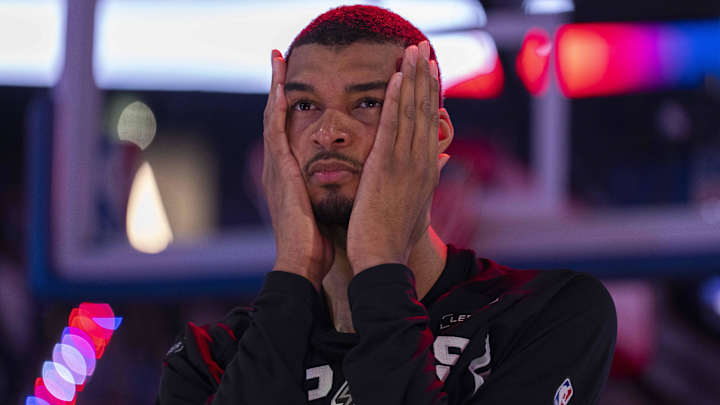
The story surrounding Victor Wembanyama this season isn’t just about dominance—it’s about inconsistency in how greatness is judged. For months, the basketball world stood in awe of his efficiency, his unprecedented stat lines, and his ability to completely alter games in limited minutes. Yet now, as award season intensifies, the very traits that once fueled his hype are being repackaged as weaknesses.
It raises an uncomfortable question: when did doing more in less time become a flaw?
Earlier in the season, Wembanyama’s performances were treated like nightly events. Social media feeds flooded with graphics showcasing absurd stat lines—50 points in under 30 minutes, multi-block games that looked more like video game outputs than real-life production. Analysts praised not just the numbers, but the speed at which he accumulated them. Efficiency wasn’t just admired—it was celebrated as revolutionary.
Now, that narrative has shifted.
As MVP discussions heat up, critics have begun pointing to his minutes played as a limitation rather than a strength. The argument subtly reframes efficiency into insufficiency: if he’s not logging 35+ minutes a night, can he truly be as valuable as others? It’s a convenient pivot, but one that ignores the essence of impact.
Because impact is where Wembanyama’s case becomes undeniable.
Metrics that measure on-court influence—particularly defensive ones—paint a picture few players in the league can rival. When he’s on the floor, his team transforms into an elite defensive unit. When he sits, that structure collapses. This isn’t a marginal difference; it’s a dramatic swing that underscores just how central he is to everything his team does.
That kind of disparity doesn’t just suggest value—it defines it.
Historically, awards like MVP and Defensive Player of the Year have leaned on a mix of team success, individual production, and narrative momentum. Wembanyama checks all three boxes, yet still faces resistance. Part of that resistance seems rooted in timing. As a young player still early in his career, there’s an unspoken hesitation to hand him accolades typically reserved for established superstars.
But that hesitation feels increasingly outdated.
We’ve seen players break timelines before. The league evolves, and occasionally, a talent emerges that forces voters to rethink their criteria. Wembanyama appears to be that kind of player. His influence isn’t theoretical or potential-based—it’s already tangible, already reshaping games in real time.
And yet, the goalposts continue to move.
Whether it’s minutes restrictions, team record debates, or comparisons to more “proven” names, there always seems to be a new qualifier introduced when his candidacy gains traction. It creates the impression that he’s being evaluated not on what he is, but on what voters are comfortable accepting.
That’s the real issue.
If the standard is dominance, he qualifies. If it’s impact, he exceeds expectations. If it’s uniqueness, he may be in a category of his own. The challenge isn’t defining his greatness—it’s deciding whether the traditional frameworks used to judge players can properly account for it.
Because right now, those frameworks seem to be failing him.
Award seasons are supposed to celebrate excellence, not complicate it. And if the criteria shift depending on the player, then the awards themselves lose clarity. Wembanyama’s season shouldn’t be controversial—it should be historic.
The only question left is whether voters are ready to acknowledge that, or if the narrative will continue to lag behind the reality unfolding on the court.