Nottingham Forest’s narrow 1–0 victory over Porto in the Europa League quarter-final second leg should have been remembered as a statement European performance. Instead, the match has become the centre of controversy after an early red card shown to Jan Bednarek changed the entire rhythm of the game.
While former Premier League referee Keith Hackett has backed the decision after reviewing the footage, not everyone agrees that the dismissal was justified, and the incident continues to divide opinion among fans and analysts.
Forest, who advanced to the Europa League semi-finals with a composed and dominant display, benefited significantly from the numerical advantage. Morgan Gibbs-White’s decisive goal capped off a strong home performance, but the turning point arrived much earlier when Bednarek was sent off for what was deemed serious foul play in a challenge involving Chris Wood.
The Incident That Changed the Game
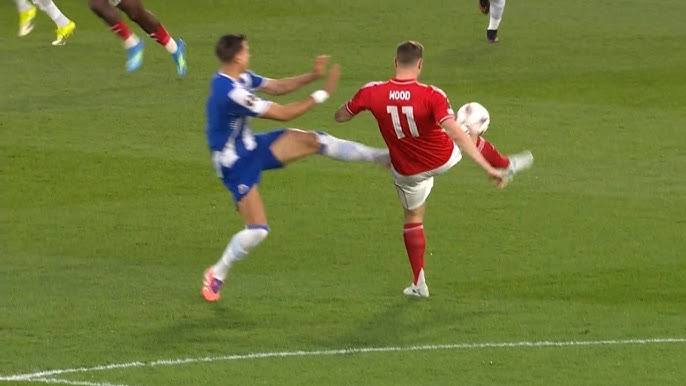
The moment in question came inside the opening exchanges, when both Wood and Bednarek contested a loose aerial ball. As they challenged, both players raised their legs in an attempt to gain control. Contact followed, with Wood going down after an apparent clash around the ankle area.
The referee initially chose not to issue any card, suggesting in real time that the challenge was part of a natural 50-50 duel. However, VAR intervened and advised a review at the pitchside monitor. After reviewing the incident, the referee upgraded the decision to a straight red card for dangerous play.
It was this intervention that shifted the tone of the entire match.
Hackett Backs the Call — But Debate Remains
Keith Hackett later stated that the referee was correct to issue a red card, describing the challenge as “high, late and with studs showing,” and concluding that it met the threshold for serious foul play.
However, this interpretation has not settled the argument.
Many observers argue that the challenge lacked clear intent and stemmed from a natural contest for a loose ball rather than reckless aggression. Both players were moving toward the same space, both attempted to play the ball, and the contact appeared to be more incidental than deliberate.
Critics of the decision also point out that Bednarek did not appear to lead with excessive force in a manner typically associated with clear red-card offences. Instead, the collision looked like an unfortunate outcome of timing rather than violent intent or uncontrolled action.
From that perspective, a yellow card—or even a no-foul continuation—was seen by some as a more balanced outcome.
The Fine Line Between Protection and Punishment
Modern officiating continues to wrestle with the interpretation of “serious foul play,” especially in fast, contested situations like this one. VAR has tightened enforcement on high and potentially dangerous contact, but it has also increased debate over whether natural footballing collisions are being over-penalised.
In this case, the subjective nature of the decision is what fuels disagreement. While one reading of the footage supports a red card based on contact point and perceived danger, another sees a routine aerial duel where both players committed equally.
Forest Capitalise as Porto Collapse
Regardless of the controversy, Nottingham Forest took full advantage of the situation. Playing with an extra man allowed them to dominate possession, control territory, and ultimately secure progression to the semi-finals, where a difficult tie against Aston Villa now awaits.
Porto, meanwhile, were left to reflect on what might have been had the game remained eleven versus eleven for longer. The early dismissal removed their tactical structure and forced them into a reactive shape for most of the contest.
Conclusion
While Keith Hackett’s backing of the red card adds authority to the referee’s decision, the incident remains far from universally accepted. The challenge sits firmly in the grey area that defines modern officiating—where intent, contact, and interpretation collide.
For Forest, the result is what matters most. But for football as a whole, the debate over consistency in red card decisions continues to grow louder.