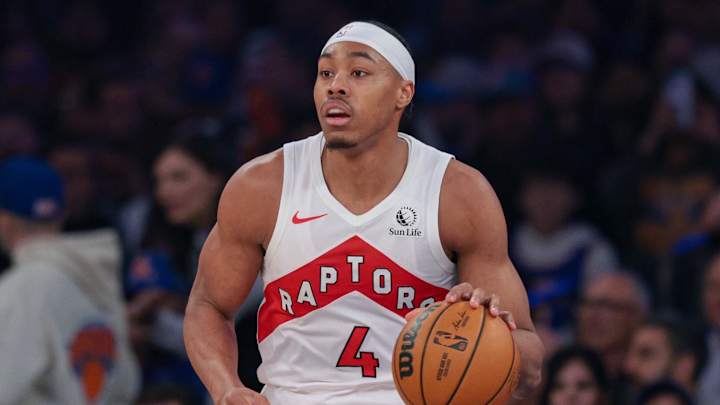
Scottie Barnes’ push toward All-NBA recognition has hit an unexpected and frustrating wall, with circumstances outside his control now playing a major role in how the race is shaping up. What once looked like a promising campaign built on consistency, durability, and two-way impact has now become a far more complicated conversation—one that no longer fully rewards availability in the way many expected.
For much of the season, Barnes was viewed as a strong candidate to at least enter the fringes of All-NBA consideration. His production remained steady, his defensive impact continued to stand out, and his role as the Toronto Raptors’ franchise cornerstone only grew more defined. Even when the team fluctuated in form, Barnes remained the stabilizing presence, routinely filling box scores with rebounds, assists, defensive stops, and timely scoring bursts.
But the conversation around All-NBA has shifted dramatically in recent weeks, largely due to how the league has handled eligibility and availability thresholds. The introduction of the 65-game rule was supposed to clarify award standards and reward consistent participation. Instead, it has already become inconsistent in its application, and that inconsistency is now reshaping the entire race.
With other high-profile players like Luka Dončić and Cade Cunningham effectively bypassing the restriction due to injury-related exemptions and special considerations, the framework has begun to blur. What was once intended as a strict benchmark now appears more flexible depending on circumstance, reputation, and narrative context. And while those exceptions may be justified individually, the wider impact is that players like Barnes—who simply played through the season without missing extended time—are left in an awkward middle ground.
Barnes’ durability, ironically, was supposed to be a strength. Playing close to a full schedule was expected to enhance his value in award conversations. Instead, it now feels less impactful in a landscape where missed games are increasingly contextualized rather than penalized. The message becomes unclear: availability matters, except when it doesn’t.
That ambiguity has consequences. Barnes’ statistical profile, while strong, has not reached the explosive peaks typically associated with All-NBA selections. He has delivered a highly efficient and reliable season, but without the late-season surge or dominant scoring stretch that often defines award locks. His production after the All-Star break, while still solid, dipped slightly below the superstar tier that voters usually prioritize when finalizing ballots.
Still, the season cannot be framed as anything other than a success for both Barnes and the Raptors. His defensive versatility remains among the best at his position, with his ability to guard multiple roles and initiate transition offense still central to Toronto’s identity. An All-Defensive selection remains highly realistic, and his overall impact continues to position him as one of the most important young forwards in the league.
Internally, the Raptors will likely view this season as another step forward in Barnes’ development rather than a setback. His leadership role has expanded, his consistency has improved, and his presence on both ends of the floor continues to anchor the team’s direction moving forward.
However, in the cold calculation of end-of-season awards, perception often outweighs progression. And right now, the perception is that other candidates have stronger narratives, bigger statistical peaks, or more favorable circumstances at exactly the right time.
For Barnes, the All-NBA conversation may not be completely over—but it has undeniably become steeper, narrower, and less forgiving. What once felt within reach now depends heavily on how voters reconcile production, availability, and reputation in a season where the rules themselves seem to keep shifting.
And that uncertainty, more than anything else, is what may ultimately define his case.