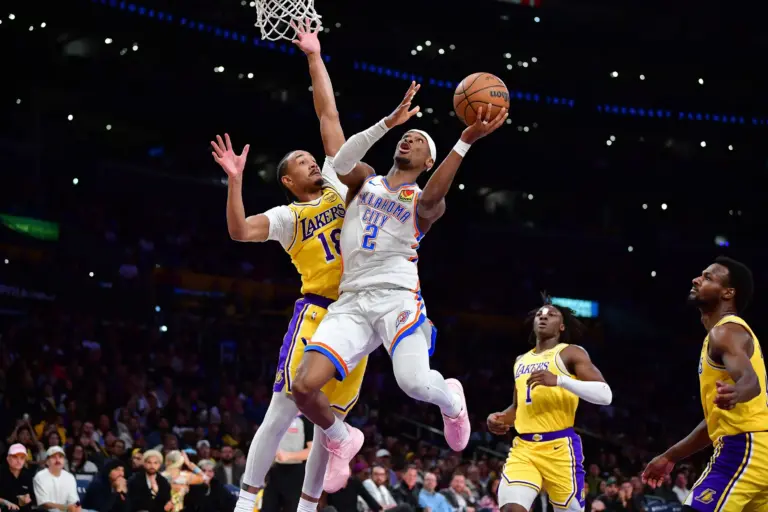
The Oklahoma City Thunder are heading into the playoffs with a narrative they didn’t exactly ask for—but can’t escape either: they may rely too much on Shai Gilgeous-Alexander.
And yet, that “problem” might be the most misleading storyline in the entire NBA.
Shai Gilgeous-Alexander has been nothing short of dominant this season for the Oklahoma City Thunder. The reigning MVP candidate has produced elite scoring efficiency, historic plus-minus impact, and the kind of consistency that usually defines championship teams—not flawed ones.
So when analysts talk about OKC’s “dependence” on him, the reality is more complicated.
The numbers that created the narrative
There’s no denying Gilgeous-Alexander’s impact. OKC’s record with him on the floor has been overwhelming, and their net rating spikes dramatically when he plays.
He’s not just their best player—he’s their offensive system, clutch solution, and stabiliser all in one. That naturally creates the perception that without him, the team would struggle to function.
But that’s where the framing gets misleading.
Every elite team in NBA history has looked “dependent” on its superstar during deep playoff runs. The difference is whether that dependence becomes a crutch—or a weapon.
Why OKC’s structure actually supports him
Unlike teams that collapse without their star, Oklahoma City have shown they can survive stretches without Gilgeous-Alexander. Their depth, ball movement, and defensive structure keep them competitive even when he’s off the floor.
Players like Jalen Williams, Chet Holmgren, and others have grown into legitimate secondary creators, easing pressure in ways that don’t always show up in box scores.
That matters in the playoffs, where scouting becomes tighter and defensive schemes are designed specifically to take away primary options.
The real issue isn’t reliance—it’s readiness
The concern isn’t that OKC rely on Gilgeous-Alexander. The concern is whether the rest of the roster is prepared for the moment when defenses inevitably force someone else to beat them in a seven-game series.
Because that moment always comes.
Playoff basketball doesn’t remove stars—it isolates them. And when that happens, contenders need at least one more player who can consistently punish defensive overcommitment.
History says this “problem” is actually normal
Championship teams are almost always defined by one unstoppable force. The 2026 Thunder are no different in that regard.
What separates contenders from champions is not reducing reliance on a star, but ensuring that reliance doesn’t become predictable.
So far, OKC’s system has done the opposite of what critics suggest—it has amplified Gilgeous-Alexander while still allowing others to step forward when needed.
So is it really a problem?
Calling it an “SGA problem” may be the wrong diagnosis entirely.
If anything, Oklahoma City’s situation reflects something closer to an advantage: they have the league’s most consistent offensive engine, surrounded by enough depth to adapt when needed.
The real danger for opponents isn’t that OKC rely on Gilgeous-Alexander.
It’s that even when they do, stopping him still hasn’t been solved.