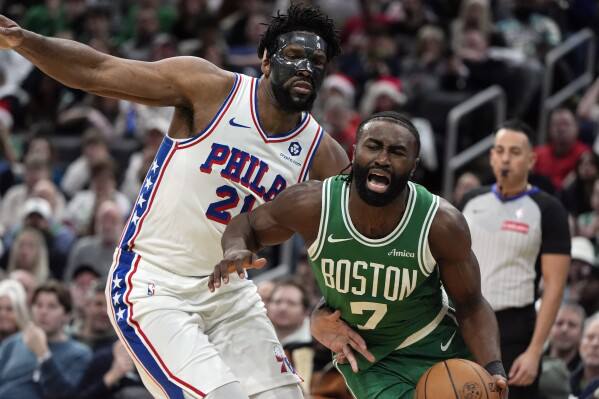
Few matchups in professional basketball carry the weight, history, and emotional scars of the rivalry between the Philadelphia 76ers and the Boston Celtics. Stretching back more than seven decades, this is not just a postseason fixture—it is the most frequently repeated playoff pairing in NBA history, with the two franchises meeting an astonishing 23 times.
Across eras, dynasties, heartbreaks, and rebuilds, Boston has largely dominated the series. But Philadelphia’s victories have often been unforgettable, dramatic, and historically significant. This rivalry is defined not by balance, but by extremes—long Celtics dominance interrupted by rare but explosive Sixers breakthroughs.
The Early Years: Syracuse Roots and Celtics Control (1950s–1960s)
The rivalry began in the early 1950s when the franchise was still the Syracuse Nationals. In those early encounters, Boston quickly asserted control, led by legends such as Bob Cousy and later Bill Russell.
One of the earliest defining moments came in 1953, when Cousy dropped 50 points in a marathon overtime win, showcasing the Celtics’ early dominance. However, Syracuse responded in 1954 and 1955, winning Eastern Division matchups and eventually capturing a championship in 1955.
Despite those brief highs, Boston’s arrival as a dynasty under Bill Russell shifted the balance permanently. From 1957 onward, the Celtics controlled the rivalry, often dismantling Syracuse and later Philadelphia teams en route to repeated NBA titles.
The late 1960s featured some of the most iconic moments in NBA history. The 1965 Eastern Division Finals included the legendary “Havlicek stole the ball!” sequence, a play that remains etched into basketball lore. By this stage, Boston’s dominance was not just statistical—it was cultural.
Wilt Chamberlain Era: Brief Sixers Glory (1967–1968)
Philadelphia’s most famous early breakthrough came in 1967, when Wilt Chamberlain led the Sixers to a dominant 4–1 series win. Alongside Hal Greer and Chet Walker, Chamberlain powered Philadelphia to its first championship in the city.
For a brief moment, it appeared the balance of power had shifted.
But Boston responded immediately.
In 1968, the Celtics completed a historic comeback from 3–1 down, eliminating Philadelphia in Game 7. That loss became one of the most painful in Sixers history and marked the end of Chamberlain’s tenure with the franchise.
Julius Erving, Bird, and the Modern Rivalry Begins (1970s–1980s)
The rivalry evolved dramatically in the late 1970s with the arrival of . In 1977, Erving led Philadelphia past Boston in a thrilling seven-game series, beginning a new competitive era.
The early 1980s became a golden period for the rivalry. Philadelphia and Boston met repeatedly in Eastern Conference Finals battles, often featuring Hall of Famers like Erving, Larry Bird, and Kevin McHale.
Philadelphia’s 1982 victory was particularly iconic, powered by Andrew Toney’s legendary “Boston Strangler” performances. That series remains the Sixers’ last playoff series win over the Celtics.
However, Boston responded again in 1981 and 1985, reinforcing their reputation for rising in the biggest moments. The rivalry during this era was defined by intensity, physicality, and razor-thin margins.
Long Gaps and Occasional Resets (1990s–2000s)
After the mid-1980s, the teams rarely met in the postseason. When they did, Boston continued to hold the advantage.
The 2002 series featured at his peak, delivering heroic performances, including a 42-point explosion in Game 3. Yet Boston ultimately prevailed in five games behind Paul Pierce’s dominant scoring display.
This period reinforced a familiar theme: Philadelphia could compete, but Boston often had the final answer.
Modern Era: Painful Near Misses (2010s–2020s)
The rivalry reignited in the 2010s with new stars and renewed expectations.
In 2012, an undermanned Philadelphia squad shocked Chicago before pushing Boston to seven games in the Eastern Conference Semifinals. Despite their resilience, talent prevailed, and the Celtics advanced.
The 2018 series delivered one of the most infamous moments in Sixers history—Game 3 confusion over a potential game-winning shot, followed by an overtime loss that swung momentum permanently in Boston’s favour.
Then came the most painful modern chapter: 2023.
Led by and James Harden, the Sixers pushed Boston to seven games again. After taking a 3–2 series lead, Philadelphia collapsed in Games 6 and 7, with poor shooting performances and missed opportunities defining another heartbreaking exit.
The Rivalry Today: Familiar Story, New Stakes
As of 2026, the Celtics lead the all-time playoff series significantly. Philadelphia’s last series win remains 1982, while Boston has consistently found ways to eliminate the Sixers in recent decades.
Yet the rivalry remains one of the NBA’s most watched and emotionally charged matchups. Every new series carries the weight of history—decades of dominance, heartbreak, and fleeting moments of redemption.
For Philadelphia, each meeting represents more than just basketball. It is an attempt to rewrite a long and painful narrative. For Boston, it is about maintaining a legacy of control over one of the league’s most persistent challengers.
Conclusion
The Sixers vs Celtics playoff history is not balanced—it is layered, emotional, and deeply entrenched in NBA lore. From Wilt Chamberlain to Julius Erving, from Allen Iverson to Joel Embiid, generations of stars have tried to tilt the rivalry.
But one fact remains unchanged: Boston almost always finds a way.
And that is what makes every new chapter in this rivalry feel like history waiting to be rewritten.