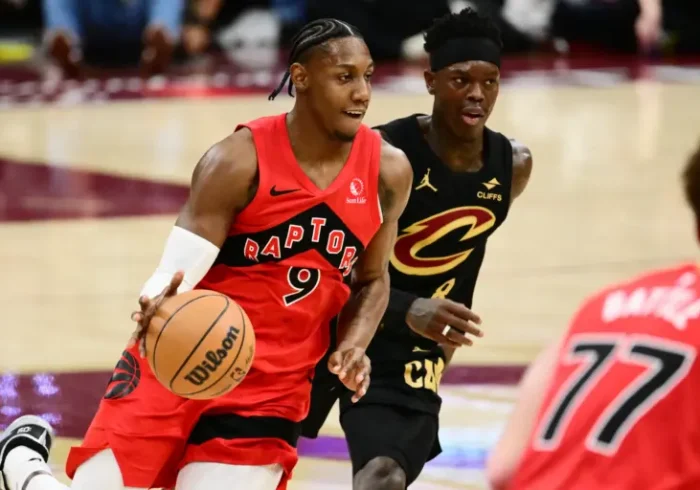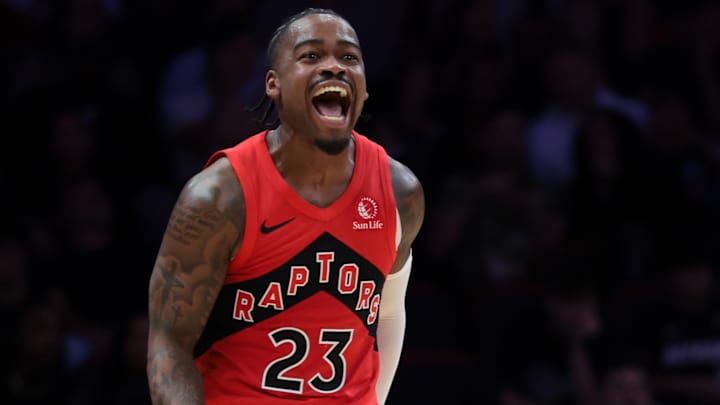
Jamal Shead may have only just stepped into his first NBA playoff game, but he wasted no time making a statement.
With Immanuel Quickley sidelined, the Toronto Raptors turned to their young guard to handle starting duties in a high-pressure Game 1 matchup against a hardened Cleveland Cavaliers team. What followed was one of the most surprising individual performances of Toronto’s postseason opener—and a rare positive in an otherwise difficult night.
Thrown Into the Fire — and Looking Comfortable
Playoff debuts are often overwhelming. The speed, physicality, and intensity expose even seasoned players. But Shead played like he belonged from the opening tip.
The sophomore guard didn’t just fill a gap—he embraced the responsibility. Operating as a primary playmaker, he looked calm, composed, and decisive against a Cavaliers defense designed to suffocate inexperienced ball-handlers.
For a player previously criticized for his scoring limitations, the moment demanded growth. And Shead delivered it immediately.
Shooting Surge Changes the Narrative
The most striking development wasn’t his passing—it was his shooting.
Shead, known more as a traditional floor general than a scoring threat, entered the game with a reputation as an inconsistent shooter from deep. Opposing teams had routinely dared him to take outside shots during the regular season.
In Game 1, that approach backfired.
He knocked down 5-of-6 from three-point range, finishing with 17 points on highly efficient shooting. It wasn’t just a hot streak—it was a level of confidence and rhythm that had rarely been seen from him before.
For a player previously viewed as a perimeter liability, the performance was a direct challenge to that narrative.
Playmaking Dip, but Role Shift Explains It
While his scoring stood out, his playmaking numbers dipped slightly, finishing with just two assists. That drop-off was largely a result of role adjustment rather than regression.
With increased scoring responsibility, Shead spent more time off the ball and in scoring positions rather than orchestrating possessions. The shift highlighted his versatility, even if it temporarily reduced his traditional impact as a facilitator.
Still, his presence stabilized Toronto’s offense during key stretches.
A Silver Lining in a Difficult Loss
Despite Shead’s breakout, the Raptors still struggled to keep pace with Cleveland’s overall execution. Shot distribution became a talking point postgame, particularly with Brandon Ingram receiving limited touches in the offensive flow.
Even so, Shead’s performance stood out as a rare positive takeaway.
His ability to step into a starting role, stretch the floor, and provide composure under playoff pressure gave Toronto something it desperately needed: unexpected production from a young player on the biggest stage.
The Bigger Picture for Toronto
The Raptors’ long-term outlook may hinge on players like Shead evolving beyond defined roles.
If he can maintain even a portion of this shooting confidence while continuing to develop as a playmaker, he becomes far more than a backup guard—he becomes a rotational weapon capable of changing playoff dynamics.
Game 1 suggested that possibility is no longer theoretical.
It’s real.
A Performance Worth Building On
Toronto didn’t get the result they wanted, but they may have uncovered something valuable in defeat.
Shead’s breakout didn’t win the game—but it may have reshaped how the Raptors view their rotation moving forward.
And in a playoff series that demands adjustments, that discovery could matter just as much as the final score.