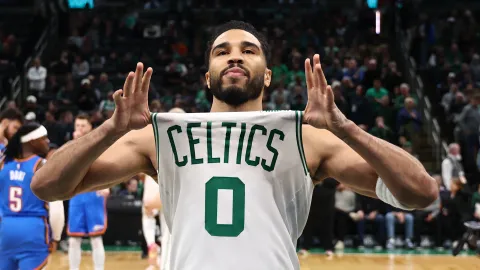
The Philadelphia 76ers came into Game 1 with a clear plan: test Jayson Tatum in isolation, push him into defensive situations, and see whether Boston’s star could still hold up after returning from injury.
They didn’t find what they were looking for.
Instead, the Boston Celtics left with a dominant 32-point playoff win, and Tatum may have delivered one of his most quietly important performances—not just offensively, but defensively.
Sixers Come Out Hunting Tatum
From the opening possessions, the Philadelphia 76ers made their intentions obvious. Head coach Nick Nurse focused early offensive sets on isolating Tatum, particularly through Tyrese Maxey, trying to force switches and create advantages.
The goal was to test his lateral movement, recovery speed, and overall defensive sharpness following his return.
But the strategy quickly ran into problems.
Tatum Answers Every Early Challenge
Maxey attacked Tatum multiple times in the first quarter, targeting him in isolation situations designed to expose any physical limitations.
The result was largely unsuccessful. Tatum stayed connected on drives, controlled angles, and forced difficult shots. Even when Maxey managed to score once on a creative finish, the broader pattern was clear—he was not consistently beating his defender.
As the game progressed, Philadelphia adjusted its approach.
Philly Quietly Abandons the Experiment
By the second quarter, isolation attempts against Tatum had already started to fade. By the second half, they were rare.
That shift was telling. When a team stops targeting a matchup mid-game, it usually means the advantage they expected simply isn’t there.
In this case, the Sixers moved away not because they succeeded—but because they didn’t.
Defensive Versatility Still Intact
Beyond isolation defense, Tatum also showed his usual versatility. He switched across multiple positions, spent time defending bigger players, and remained active in help situations.
Boston leaned heavily on its switch-heavy defensive system, with Tatum at the center of it. Despite recent injury concerns, he appeared comfortable moving between roles without losing effectiveness.
That kind of flexibility has long been a key part of Boston’s defensive identity.
The Numbers Back It Up
Philadelphia shot just 6-of-19 when Tatum was the primary defender. While single-game stats don’t define a series, the numbers aligned with what was seen on the floor: contested looks, disrupted drives, and limited clean scoring opportunities.
More importantly, Philadelphia’s willingness to attack him directly declined as the game went on.
Why This Matters for Boston’s Title Push
Playoff basketball is about finding weaknesses and exploiting them repeatedly. The Sixers tried that with Tatum—and didn’t find a reliable edge.
That matters because Boston’s defensive system relies on switching and positional trust. If Tatum can consistently handle perimeter pressure and mismatches, it preserves the integrity of the entire structure behind him.
Conclusion: The Test Didn’t Break Him
The Sixers did what playoff teams are supposed to do—go after a perceived vulnerability.
But instead of exposing a flaw, they may have confirmed the opposite.
Jayson Tatum’s defense isn’t just surviving in the postseason—it’s still a strength.
And for Boston, that might be one of the most important developments of their entire playoff run.