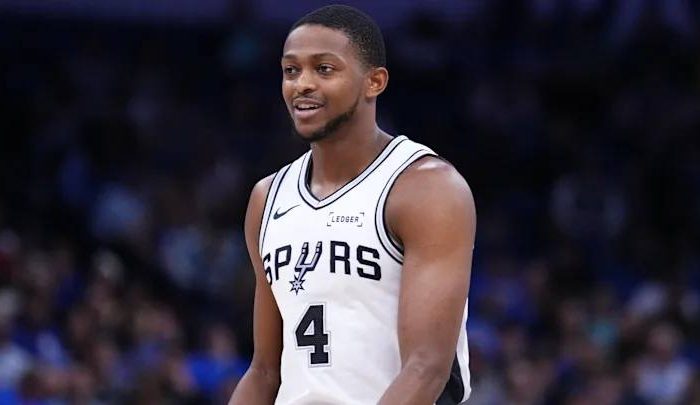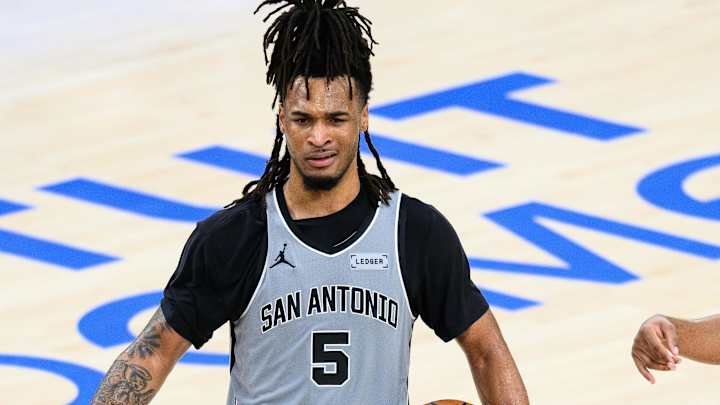
Stephon Castle’s first playoff series has started with promise, but for the San Antonio Spurs, “good” is no longer enough. With Victor Wembanyama sidelined due to a concussion and De’Aaron Fox struggling to find rhythm, the responsibility on the sophomore guard has suddenly grown far heavier—and far more urgent.
Through the first two games against the Portland Trail Blazers, Castle has shown exactly why the Spurs believe in his long-term potential. He has played with confidence, attacked the rim aggressively, and contributed across multiple areas of the game. But while his all-around impact has been noticeable, the Spurs now need him to take another leap entirely.
So far, Castle is averaging 17.5 points, 7.0 rebounds, 6.0 assists, and 1.0 steals per game in the series. On paper, those are strong numbers for a young player in his first postseason appearance. His ability to push downhill, create pressure on defenses, and facilitate for teammates has been a key part of San Antonio’s offensive flow.
His defensive presence has also stood out. Castle has been active, disruptive, and engaged on that end of the floor, forcing a combined seven turnovers across the first two games. That level of intensity has helped keep the Spurs competitive, especially against a physical Portland team.
However, the deeper reality of the series is becoming increasingly clear: the Spurs need more.
With Wembanyama unavailable, San Antonio’s margin for error has shrunk dramatically. The absence of their defensive anchor and offensive focal point has shifted more responsibility onto Castle’s shoulders. What was once a developmental playoff experience has quickly turned into a test of leadership and production under pressure.
The biggest concern so far has been efficiency. Castle is shooting just 33% from the field through two games, including 27.3% from three-point range and 36.4% on two-point attempts. While his outside shooting was never expected to be his strongest weapon, his struggles inside the arc have been more damaging.
Portland’s defensive approach has played a role in that inefficiency. The Trail Blazers have used their size and physicality to clog driving lanes and challenge Castle at the rim. Players like Donovan Clingan and Robert Williams have made it difficult for him to finish cleanly, often forcing him into awkward angles or contested attempts.
Still, the Spurs cannot simply attribute the struggles to defensive pressure alone. As one of the primary offensive creators in Wembanyama’s absence, Castle is being asked to convert more of his opportunities. The aggressiveness is there—but the finishing consistency is not yet at the level San Antonio needs.
What makes the situation more pressing is the lack of alternative scoring options stepping up consistently. Without Wembanyama anchoring the offense, the Spurs are relying heavily on Castle to both generate and convert offense. That dual responsibility is difficult for any player, let alone a sophomore making his playoff debut.
Even so, the belief within the organization remains strong. Castle’s strengths—his athleticism, playmaking instincts, and ability to pressure defenses—are exactly what the Spurs need to stay competitive. The challenge now is turning those strengths into more efficient production.
There is still time for that adjustment to happen. One or two strong performances could completely shift the tone of the series. The Spurs are not outmatched, but they are clearly operating without their full identity, and that makes Castle’s development in real time even more important.
San Antonio knows what he is capable of. The tools are already visible. The next step is consistency—finishing plays, improving efficiency, and delivering at the level required when the stakes rise.
Because right now, “promising” is no longer enough.