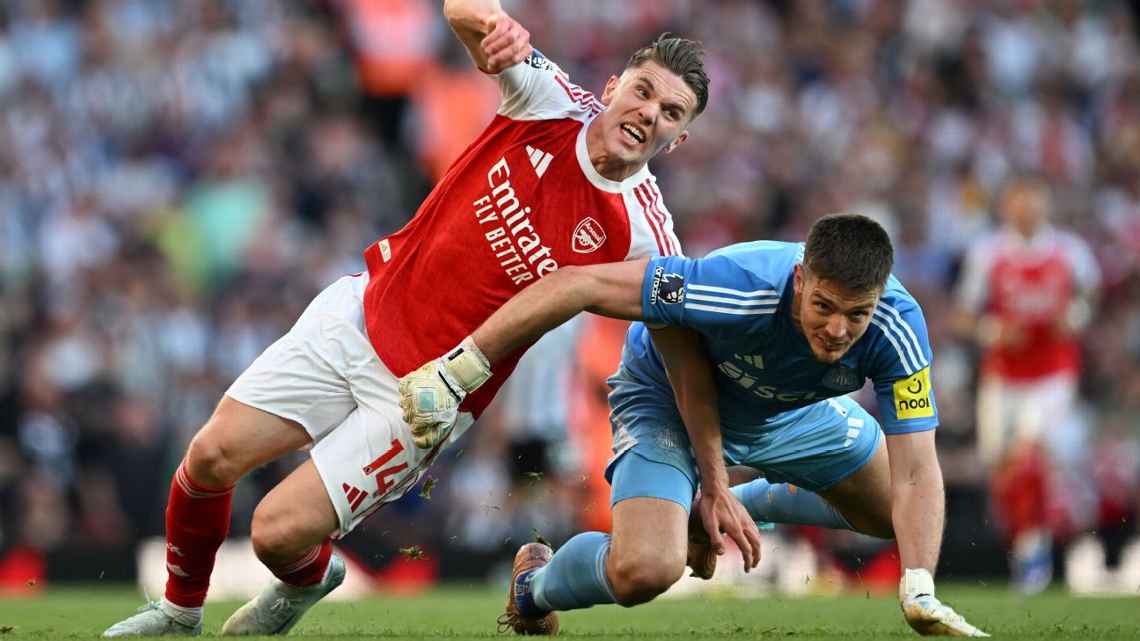
The Premier League’s ongoing VAR controversy has once again taken centre stage after Arsenal’s 1-0 win over Newcastle United, with a major talking point emerging from Nick Pope’s collision with Viktor Gyökeres. While officials upheld a yellow card on review, a closer analysis of the incident strongly suggests the decision should have been upgraded to a red card for denial of an obvious goal-scoring opportunity.
The incident occurred in the 74th minute when Arsenal forward Gyökeres latched onto a through ball that exposed Newcastle’s back line. With only the goalkeeper to beat and the ball bouncing in a dangerous area, Pope rushed out of his penalty area in an attempt to intercept. What followed was a mistimed and desperate challenge that saw the Newcastle goalkeeper bring down the Arsenal striker illegally as he attempted to recover the loose ball.
Referee Sam Barrott initially showed a yellow card, judging that the situation did not meet the threshold for a red card. That decision was later checked by VAR official Jarred Gillett, who chose not to intervene and confirmed the on-field call.
However, under the Laws of the Game regarding denial of an obvious goal-scoring opportunity (DOGSO), there is a strong argument that Pope’s actions meet all the required criteria for a sending-off.
Clear attacking opportunity denied
Gyökeres had already broken beyond the last line of Newcastle defenders, with his path toward goal relatively unobstructed. The ball was under his control or close enough for a realistic chance of control, and his momentum was clearly taking him into a one-on-one situation with an open scoring opportunity.
The fact that Pope left his penalty area and committed a foul to stop the attack removes any doubt that he attempted to prevent a potential goal-scoring chance. In such situations, refereeing guidelines typically place significant weight on whether the attacker is moving toward goal with control or a reasonable chance of gaining control — both of which were present here.
Defensive cover argument is weak
The justification given for the VAR non-intervention was the presence of a covering defender who, in theory, could have recovered the situation. However, this interpretation is highly debatable.
In practice, the covering defender was not in a position to realistically challenge Gyökeres before he could either regain control or take a shot. DOGSO criteria require more than theoretical coverage — it requires a genuine likelihood of defensive recovery, which appears absent in this case.
This is precisely where VAR consistency comes into question. In similar Premier League scenarios, attackers have been judged to have clear goal-scoring opportunities even when defenders are trailing several yards behind the play.
Pope’s action fits DOGSO criteria
Under Law 12, referees must consider distance to goal, direction of play, likelihood of control, and number of defenders. In this incident:
- The attack was moving directly toward goal
- Gyökeres was ahead of the last defender
- Control of the ball was highly likely given his position
- Defensive recovery was minimal at best
Taken together, these factors strongly indicate a DOGSO offence.
Even though Pope’s challenge may not have been malicious, intent is not required for a red card in DOGSO situations. The outcome and impact on the attacking move are what matter — and here, a clear goalscoring chance was taken away.
VAR inconsistency fuels frustration
Arsenal manager Mikel Arteta was left visibly frustrated after the match, and while his broader comments often attract debate, on this occasion there is a strong case that his assessment was correct. Similar incidents in other fixtures have resulted in red cards, making the consistency of VAR interpretation once again a key issue.
Former referees have defended the on-field decision, but scrutiny of the laws suggests that a stricter application would likely have led to Pope being sent off.
Conclusion: A missed red card decision
While VAR is designed to correct clear and obvious errors, this incident highlights how subjective interpretation continues to influence outcomes. Based on positioning, opportunity, and the nature of the foul, Nick Pope’s challenge on Viktor Gyökeres should have resulted in a red card for denial of an obvious goal-scoring opportunity.
Instead, a major moment in the match was left unresolved — and once again, the consistency of VAR decisions remains under the spotlight.