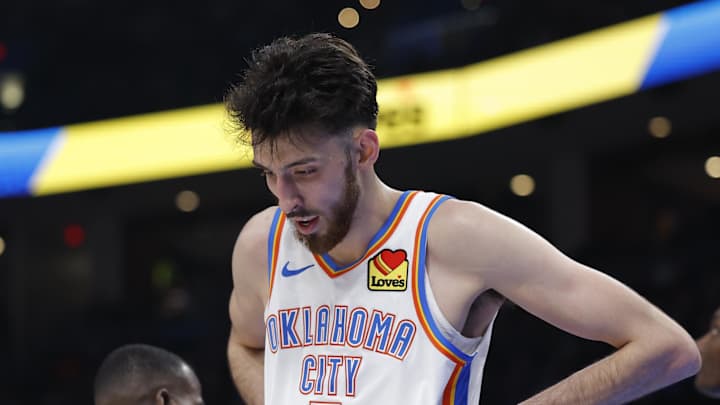
The Oklahoma City Thunder may be cruising through their first-round playoff series, but a bigger test is quietly taking shape—one that centers on the continued development and responsibility of Chet Holmgren.
With a commanding 3-0 lead over the Phoenix Suns, Oklahoma City has looked in control despite the absence of key contributor Jalen Williams, who remains sidelined with a hamstring injury. The team’s cohesion, depth, and defensive intensity have proven too much for a Suns side already dealing with its own personnel issues. On the surface, there is little cause for concern.
However, beyond this series lies a more demanding challenge, and Holmgren’s role within it is becoming increasingly significant.
Throughout the regular season, Holmgren established himself as one of the league’s premier defensive forces. His rim protection, timing, and versatility were instrumental in the Thunder’s rise, earning him strong recognition in Defensive Player of the Year conversations. Yet while his defensive impact has been undeniable, questions have persisted regarding his offensive assertiveness.
To his credit, Holmgren made noticeable strides in that area late in the season. Over the final stretch, he displayed increased confidence, taking on more scoring responsibility and showing a willingness to attack inside. His efficiency improved, and he began to look more comfortable creating his own opportunities rather than relying solely on the flow of the offense.
But the playoffs demand a different level of consistency and intent.
With Williams unavailable, Oklahoma City needs Holmgren to take another step forward—this time under postseason pressure. The expectation is not for him to become the team’s primary scorer, especially with Shai Gilgeous-Alexander leading the offense, but rather to serve as a reliable secondary option who can capitalize when defenses focus elsewhere.
So far, that transition has been gradual at best.
In Game 3 against Phoenix, Holmgren was efficient with the opportunities he took, converting the majority of his attempts. However, the more concerning detail was his reluctance to seek out those chances. Despite the increased responsibility in Williams’ absence, Holmgren attempted only a handful of shots, often opting to defer to teammates instead of asserting himself offensively.
That approach may not be sustainable as the competition intensifies.
Looking ahead, the Thunder are likely to face far more organized and defensively disciplined opponents. A potential matchup with a team like the Los Angeles Lakers—especially if they regain key personnel—would demand greater offensive balance. Opponents will inevitably focus on limiting Gilgeous-Alexander, forcing others to step up and make plays.
In that scenario, Holmgren’s ability to contribute consistently on offense could become a deciding factor in how far Oklahoma City can advance.
The tools are clearly there. His size, skill set, and shooting touch make him a difficult matchup when he plays with confidence. He has already shown flashes of what he can become—a versatile big man capable of impacting the game on both ends. The challenge now is translating that potential into assertive, repeatable production in high-stakes situations.
For the Thunder, this is less about surviving the current series and more about preparing for what comes next. The foundation of a deep playoff run often lies in adaptability, and Holmgren’s development could provide exactly that.
As the postseason progresses, the spotlight will increasingly shift toward him. Whether he embraces that responsibility could ultimately shape not only this playoff run but the trajectory of the Thunder’s rise as a contender in the Western Conference.