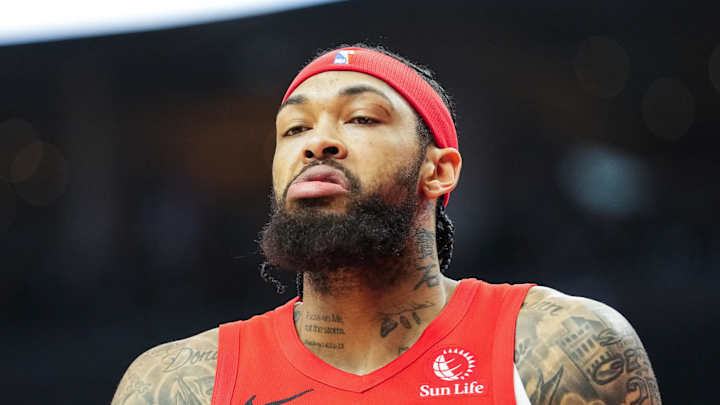
The Toronto Raptors’ playoff push has brought a harsh spotlight onto one of their biggest acquisitions, as Brandon Ingram’s early postseason struggles continue to raise serious questions about his long-term fit with the team.
What was expected to be a key scoring weapon for Toronto has instead turned into a growing concern. Through the opening stretch of the series against the Cleveland Cavaliers, Ingram has been unable to find rhythm on either end of the floor, with his impact numbers reflecting a steep decline in effectiveness.
Ingram’s impact numbers raise alarms
Despite starting and playing significant minutes, Ingram’s on-court production has been difficult for Toronto to rely on. In limited competitive stretches during the series, the Raptors have been heavily outscored with him on the floor, while showing a dramatic improvement when he sits.
Across his playoff minutes so far, Toronto’s net rating has dipped significantly whenever he is on the court, highlighting a stark contrast between expectation and reality. In Game 3, head coach Darko Rajaković made the notable decision to reduce Ingram’s closing minutes, instead turning to deeper rotation options that provided more energy and shooting.
One of those adjustments paid immediate dividends, as bench forward Jamison Battle delivered a strong scoring burst, knocking down multiple three-pointers and helping stabilize Toronto’s offense late in the game.
Ingram, meanwhile, has struggled to stretch the floor consistently, with his outside shooting remaining inconsistent and his defensive engagement under scrutiny.
Tactical concerns growing in Toronto
Beyond the shooting slump, concerns have also emerged around how Ingram fits within the Raptors’ offensive structure. His preference for isolations and mid-range scoring has often slowed the team’s ball movement, particularly against a disciplined Cavaliers defense that has effectively limited his space to operate.
Toronto’s offense has looked noticeably more fluid in stretches where Ingram has been off the court, allowing players like Scottie Barnes and Immanuel Quickley to push the pace and create more dynamic scoring opportunities.
As a result, the coaching staff faces a difficult balancing act between maximizing Ingram’s talent and maintaining overall team efficiency.
Trade discussions begin to surface
Given the size of his contract and the team’s investment, Toronto cannot easily move on from Ingram. However, early playoff struggles have already sparked speculation around potential offseason solutions if the fit does not improve.
League-wide discussions have even linked the Raptors to alternative wing options, including New York Knicks forward Mikal Bridges, as a possible stylistic replacement.
Bridges offers a different profile—more defensive versatility, better off-ball movement, and a more consistent perimeter shooting track record. In contrast to Ingram’s isolation-heavy game, Bridges would theoretically complement Toronto’s existing core more naturally, particularly alongside Scottie Barnes.
A crossroads for Toronto’s direction
For now, Toronto remains committed to competing in the present, but Ingram’s postseason form has undeniably complicated their outlook. His production swing between regular season expectations and playoff reality has become one of the defining storylines of the series.
While it is still early, the Raptors are already confronting a difficult question: whether their current roster construction can realistically contend at the highest level, or whether significant changes may be required if results do not improve.
What was once viewed as a major acquisition is now becoming a major talking point—and Toronto’s next steps could shape the franchise’s direction for years to come.