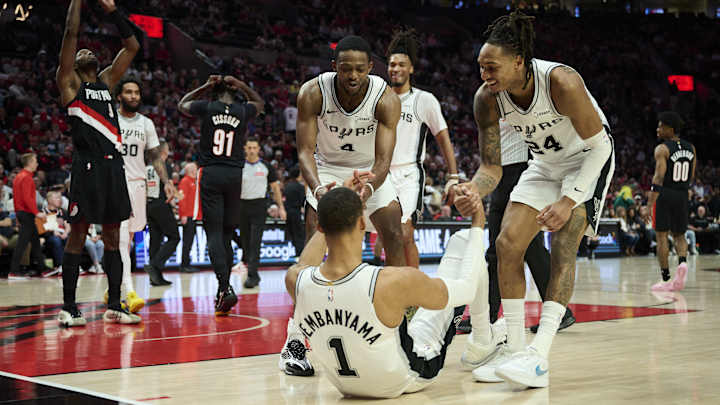
The San Antonio Spurs are quickly building a playoff identity that’s becoming increasingly difficult for opponents to solve—and it has nothing to do with relying on a single superstar carrying the load every night.
Instead, their postseason success is being driven by balance, depth, and constant rotation of offensive leadership. In their Game 4 win over the Portland Trail Blazers, that formula was once again on full display as multiple players stepped up at key moments to secure a crucial victory on the road.
Rather than leaning on one dominant scorer, San Antonio continues to win through collective effort. Each game in the series has featured a different primary offensive weapon emerging to lead the charge. In Game 1, Victor Wembanyama delivered a dominant 35-point performance. In Game 3, Stephon Castle took over with 33 points. And in Game 4, De’Aaron Fox led the way with 28 points, providing the late-game scoring punch needed to close things out.
That constant rotation of heroes has made the Spurs nearly impossible to game-plan against. Opposing defenses cannot key in on a single player without risking another stepping into a starring role. Whether it’s Wembanyama’s inside dominance, Fox’s perimeter creation, or Castle’s emerging confidence as a scorer, the Spurs always seem to have another answer waiting.
Even more impressive is how these scoring bursts are often complemented by different players swinging momentum in critical stretches. Devin Vassell has delivered explosive runs in key moments, while rookie Dylan Harper has provided timely scoring off the bench. Each contribution reinforces the same theme: San Antonio does not depend on a single formula to win games—they adapt on the fly.
This flexibility is what makes the Spurs so dangerous in a playoff setting. In most series, shutting down a team’s top scorer can significantly tilt the outcome. Against San Antonio, however, that strategy is far less effective. An off night from one star simply opens the door for another to take over.
Beyond scoring, the Spurs’ depth extends into every phase of the game. Wembanyama anchors the defense with elite rim protection, Fox drives offensive creation, Castle facilitates and attacks, and others contribute energy, rebounding, and hustle plays. The roster is built on complementary skill sets that allow the team to remain competitive no matter the matchup or game situation.
This level of balance is not accidental. It reflects a clear organizational philosophy centered on shared responsibility and role acceptance. Each player understands their function within the system and executes it without hesitation, allowing the team to operate as a cohesive unit rather than a collection of isolated stars.
As the postseason progresses, that identity only becomes more dangerous for the rest of the league. Teams that rely heavily on matchup targeting or star containment may find themselves overwhelmed by San Antonio’s constant wave of contributors.
If this trend continues, the Spurs won’t just be a tough playoff opponent—they’ll be one of the most unpredictable and frustrating teams to eliminate.