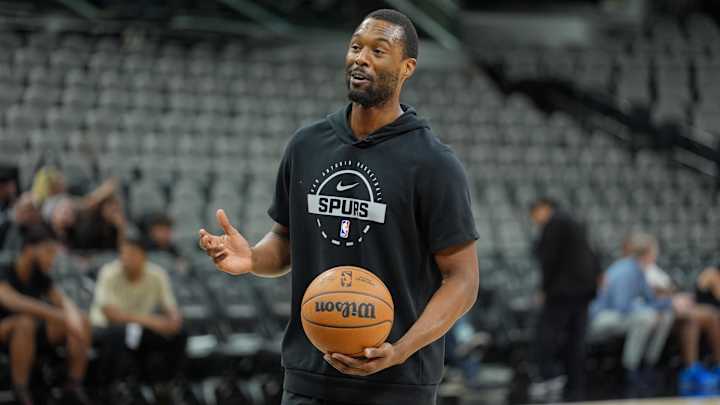
The San Antonio Spurs’ playoff rotation is starting to take shape at exactly the wrong time for veteran forward Harrison Barnes, whose role has quietly diminished as the postseason has progressed.
Across the first four games of their series against the Portland Trail Blazers, Barnes has seen a sharp decline in playing time. After opening the series with modest minutes in Games 1 and 2, his court time dipped even further in Game 3 before slightly rebounding in Game 4. The overall trend, however, is clear: he is no longer a central piece in head coach Mitch Johnson’s rotation plans.
What makes the situation notable is that Barnes hasn’t necessarily played poorly. In limited minutes, he has remained steady and serviceable. The issue is less about his performance and more about lineup dynamics and emerging alternatives within the roster.
One of the biggest factors behind his reduced role is the rise of rookie forward Carter Bryant. The young wing has begun carving out a meaningful place in the rotation, largely due to his energy on defense and increasing confidence as a floor spacer. His Game 3 performance stood out in particular, where his defensive impact helped swing momentum in favor of San Antonio during a comeback win. Even in Game 4, despite a reduced workload after the return of Victor Wembanyama, Bryant still managed to contribute efficiently from beyond the arc.
Bryant’s skill set—especially his ability to defend multiple positions while knocking down three-point shots—has made him a natural fit in the Spurs’ evolving playoff structure. As a result, he has effectively become a direct competitor for minutes that previously went to Barnes.
The ripple effect has also been felt by other rotation players, including Julian Champagnie, as Johnson experiments with combinations that maximize spacing and defensive versatility. In many ways, the coaching staff appears to be prioritizing long-term development and matchup flexibility over established veteran usage.
This shift has sparked speculation about Barnes’ future in San Antonio. While he still provides value as a reliable bench scorer and veteran presence, his role appears to be shrinking at a time when younger players are rapidly ascending. If Bryant continues his upward trajectory, he could potentially secure a starting or high-leverage role next season, further squeezing Barnes out of consistent minutes.
Given that context, it’s possible Barnes could be entering his final stretch with the Spurs. His current role—short bursts off the bench—may be the ceiling moving forward unless roster changes or injuries alter the rotation landscape.
For now, Barnes remains professional and productive in limited opportunities, but the direction is unmistakable: San Antonio is leaning into its youth movement, and the postseason has accelerated that transition faster than expected.