The rest of the NBA spent the last two years comforting themselves with a safer narrative: the San Antonio Spurs were a future problem. They were a team to be feared in 2028 or 2029, a project to watch develop safely from the upper echelon of the Western Conference.
That comforting illusion has officially shattered.
As the second round of the 2026 NBA Playoffs gets underway, the defending champion Oklahoma City Thunder are about to discover a terrifying truth that the Minnesota Timberwolves just learned the hard way. The Silver and Black didn’t just rebuild; they accelerated the standard NBA timeline, transforming themselves from a “cute young group” into a right-now championship threat.
The Six-Game Warning Shot
The signs have been flashing for months, though many chose to ignore them. San Antonio quietly handled the Thunder during the regular season, turning in a commanding 4-1 head-to-head record.
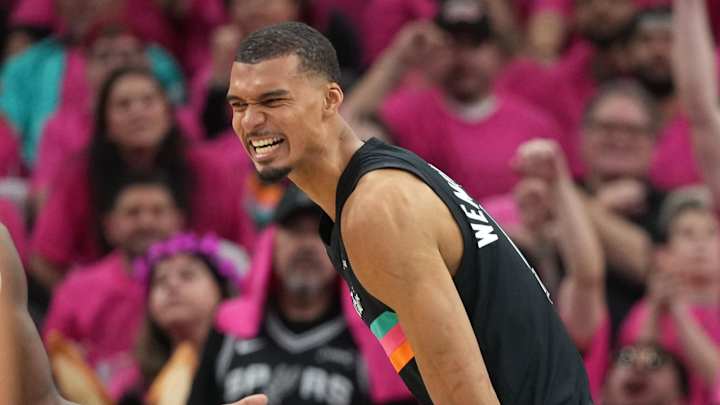
If skeptics thought that regular-season dominance wouldn’t translate to the postseason, the first round provided an absolute statement. The Spurs systematically dismantled a physical, elite Minnesota Timberwolves squad in six games. Frankly, the series likely would have wrapped up sooner had 22-year-old phenom Victor Wembanyama not been controversially ejected from Game 4.
Minnesota tried every defensive trick in the book: throwing suffocating length at Wembanyama, crowding the paint, and imposing hyper-physical, borderline dirty tactics. None of it left a dent. The Spurs responded with overwhelming force, exposing a roster structure that is uniquely engineered to neutralize elite defensive pressure.
A Backcourt Engineered to Absorb the Thunder’s Chaos
Oklahoma City typically breaks opposing offenses using the perimeter terrorism of Lu Dort and Alex Caruso. Their defensive identity relies on roughing up primary ball-handlers, rushing decisions, and forcing primary initiators into isolation exhaustion.
That strategy completely falls apart against the modern iteration of San Antonio. The Spurs possess a luxury of riches in their backcourt that few teams can match:
- De’Aaron Fox: The veteran engine capable of exploding offensively and breaking down elite perimeter defenders with his historic end-to-end speed.
- Stephon Castle: The sophomore guard who has looked entirely fearless on the playoff stage, effortlessly pivoting from defensive stopper to primary playmaker.
- Dylan Harper: The rookie sensation who attacks the paint with the strength and confidence of a ten-year veteran.
If the Thunder blitz Fox, Castle steps up to dictate the tempo. If Castle sits, Harper attacks the rim like a freight train. The backcourt pressure from San Antonio never stalls. They roll out wave after wave of dynamic playmakers until the opposing perimeter defense is the one that cracks under the physical demand.
The Generational Math of Victor Wembanyama
The Thunder have comfortably operated as the NBA’s developmental gold standard, using the twin-tower frontcourt of Isaiah Hartenstein and Chet Holmgren to control the interior. Against San Antonio, that structural advantage completely evaporates.
While Shai Gilgeous-Alexander is an undeniable MVP-caliber force who can casually drop 40 points on any given night, high-volume scoring happens across the league every week. What Wembanyama brings to the floor cannot be replicated by any individual in modern basketball.
At 22 years old, Wembanyama is already a transcendent defensive anchor, capable of completely swallowing an opponent’s offensive scheme through his mere baseline presence. Yet, it’s his rapid offensive evolution—combining deep perimeter gravity with an un-guardable interior touch—that changes the entire playoff equation. The Thunder are accustomed to dealing with elite individual talents; they are entirely unequipped for an elite ecosystem orbiting a generational force.
The Supporting Cast Igniting the Avalanche
Gregg Popovich famously spent years preaching the importance of continuity, development, and not skipping steps during a painful post-dynasty rebuild. The Spurs didn’t break that vow—they just drafted so exceptionally well that the steps grew smaller.
Wembanyama isn’t carrying a mediocre roster on his back. Alongside the multi-headed point guard monster of Fox, Castle, and Harper, the Spurs boast explosive, elite floor-spacers in Devin Vassell and Keldon Johnson, both capable of catching absolute fire without a moment’s warning.
The league kept telling itself the Spurs were still a few seasons away because that thought made the Western Conference feel manageable. But as the series shifts to Oklahoma City, the Thunder are about to look directly into a harsh new reality. The Spurs have arrived ahead of schedule, and there may not be a single team left in the league with a clean answer for what they’ve built.
Playoff Verdict: OKC earned the right to be the conference benchmark, but regular-season metrics don’t account for the postseason growth of a generational superstar. If the Thunder can’t find a way to break San Antonio’s relentless multi-guard rotation, a changing of the guard in the West is coming a lot sooner than expected.