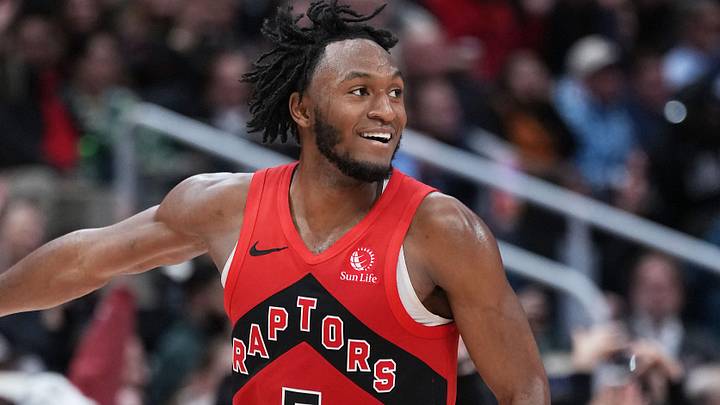
The NBA offseason rumor mill is officially heating up, and at the center of the latest speculation is a potential blockbuster involving the Toronto Raptors’ starting point guard, Immanuel Quickley. Despite a strong campaign in Toronto, questions are beginning to emerge about whether the Raptors should cash in on their floor general to solve long-term roster concerns.
As the league eyes potential shake-ups, the Houston Rockets have emerged as a prime trade partner. But the big question remains: Is trading a consistent offensive engine like Quickley a genius masterstroke or a massive mistake?
The Case for Keeping Quickley
For Raptors fans, the idea of moving Quickley is understandably divisive. Throughout the 2025/26 season, he was a pillar of consistency, averaging 16.4 points and 5.9 assists while playing an incredibly durable 67 of the team’s first 70 games. On a roster that is notoriously starved for elite three-point shooting and half-court offensive creation, Quickley was arguably the most reliable source of perimeter scoring. He attempted 6.8 threes per game—the highest mark on the team—and provided a level of offensive stability that the Raptors desperately needed. For a team trying to build around Scottie Barnes, losing a player who fits so perfectly into the modern NBA mold is a high-stakes gamble.
The “Playoff Paradox”: Why a Trade is Being Considered
So, why would Toronto even consider listening to offers? The answer lies in the postseason. When the Raptors pushed the powerhouse Cleveland Cavaliers to the brink of elimination, the narrative surrounding the team shifted. Scottie Barnes emerged as a legitimate superstar-level threat, leading the charge on a stage that proved the Raptors could be competitive even without Quickley, who missed the series due to injury.
That success ignited a fair debate: With three years and nearly $100 million left on his contract, are Quickley’s massive financial commitments the best use of Toronto’s cap space? If the Raptors have found a way to win without him, could those resources be better allocated toward filling other glaring holes on the roster?
Houston Rockets: The Ideal Trade Partner?
Enter the Houston Rockets. Like Toronto, Houston is hungry for offensive creation and floor spacing. A trade between the two makes tactical sense for both parties.
If the Raptors are going to bite, the asking price must be significant. The dream target for Toronto would be Reed Sheppard, the No. 3 overall pick in the 2024 NBA Draft. While Sheppard has faced scrutiny for his defensive limitations, his elite shooting ability makes him a tantalizing prospect for a team that needs floor spacers.
If Houston remains protective of their young stars, a veteran alternative has emerged: Fred VanVleet. A former Raptors icon, VanVleet has a one-year, $25 million player option remaining on his deal. If VanVleet were willing to opt into that final year, the Raptors would secure a massive financial “win.” By moving Quickley’s long-term salary for VanVleet’s expiring contract, Toronto would clear the decks, creating the financial flexibility needed to aggressively upgrade their roster in the 2027 offseason.
The Final Word: To Trade or Not to Trade?
Ultimately, the Raptors aren’t forced to trade Quickley. He remains a critical piece of the puzzle who directly addresses the team’s greatest weaknesses. However, the front office has a duty to listen. If Houston comes to the table with a package that provides either a high-ceiling prospect like Sheppard or the path to clearing the books, Toronto has to do their due diligence.
For the Raptors, this is no longer just about next season—it’s about the long-term vision. Is Quickley the future, or is he the ticket to an even bigger, bolder rebuild?