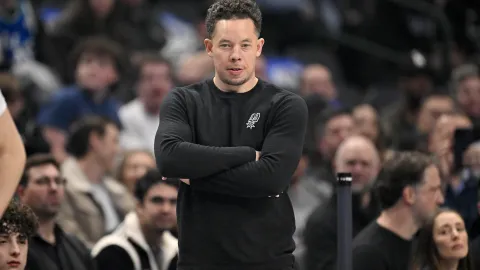
The San Antonio Spurs’ championship run ended in brutal fashion after a stunning Game 5 collapse against the New York Knicks in the NBA Finals, a loss that shifted attention away from the players and directly onto head coach Mitch Johnson’s controversial decisions.
What looked like a controlled Spurs victory for most of the night turned into a nightmare finish, as San Antonio carried a lead into the fourth quarter before completely unraveling. The Knicks stormed back with a decisive 16-point comeback to steal a 94–90 win and end the series in devastating fashion for the Spurs.
A GAME THAT SLIPPED AWAY WHEN IT MATTERED MOST
For three quarters, the Spurs appeared to be in control. Their rotations were steady, their young core was energetic, and the offense was functioning well enough to maintain a lead over New York.
But everything changed in the final stretch.
Instead of adjusting his rotation to match the Knicks’ surge, Johnson doubled down on his established approach — a decision that quickly became the focal point of postgame criticism.
The Knicks capitalized, tightening their defense and forcing San Antonio into inefficient possessions. Once momentum flipped, the Spurs had no answer.
BARKLEY’S HALFTIME WARNING IGNORED
The turning point in the conversation came from an unexpected source: Charles Barkley.
During halftime analysis, Barkley questioned Johnson’s rotation choices and urged him to lean more heavily on the Spurs’ younger, high-energy players — specifically Dylan Harper and Stephon Castle — rather than relying on De’Aaron Fox to carry the offense late.
Barkley’s message was blunt: the Spurs needed urgency, not familiarity.
“I hate to say this… you’ve got to go with Castle and Harper,” Barkley said, stressing that Johnson should prioritize performance over hierarchy in a high-pressure Finals moment.
But Johnson stuck with his original plan.
FADING TRUST IN THE WRONG MOMENT
Despite Barkley’s warning and the visible impact of the younger players, Johnson continued to trust Fox to lead the offense down the stretch.
That decision backfired.
Fox struggled heavily, finishing with just 7 points and 5 assists while shooting 3-for-15 from the field and 1-for-8 from three-point range — a performance that left the Spurs’ offense stagnant when they needed firepower most.
Meanwhile, Dylan Harper delivered the kind of explosive performance that raised even more questions about his limited role earlier in the season and in this game. The rookie put up 25 points, 5 rebounds, and 4 assists, shooting efficiently and consistently attacking the Knicks’ defense.
Stephon Castle also provided the type of energy Barkley had referenced, but the Spurs never fully leaned into that direction.
LOCKER ROOM QUESTIONS AND SECOND-GUESSING
After the game, tension lingered beneath the surface.
Devin Vassell revealed that Harper had expressed frustration at times during the season regarding his playing time — a detail that only intensified scrutiny of Johnson’s rotation strategy in a Finals elimination game.
Even as Harper produced at a high level, Johnson remained committed to the same structure that had brought them this far — a structure that ultimately broke down at the worst possible moment.
THE FINAL VERDICT
The Spurs’ season didn’t end because of one play or one possession. It ended because of a decision-making philosophy that never adapted when the pressure peaked.
The Knicks executed when it mattered most. The Spurs did not adjust when they needed to most.
And in the aftermath of a 94–90 Finals loss, one question now defines the narrative in San Antonio:
Did Mitch Johnson cost his team a championship by ignoring the very adjustment Charles Barkley was demanding at halftime?
For a franchise still chasing its first title since 1999, that question will linger far longer than the final buzzer.